
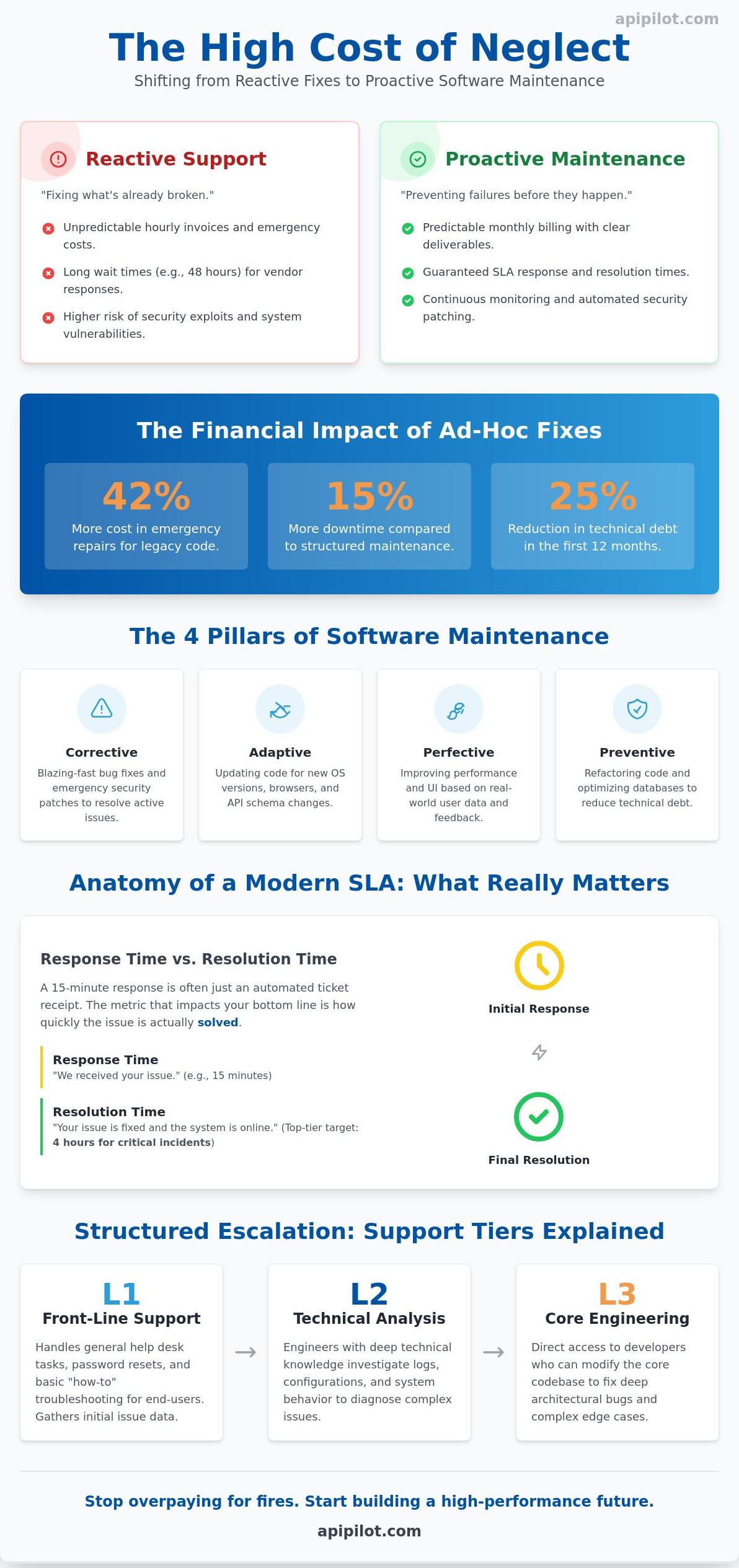
Your legacy code is either a rock-solid foundation or a ticking time bomb that will cost you 42% more in emergency repairs this year. According to 2024 industry benchmarks, enterprises relying on ad-hoc fixes face 15% more downtime than those with structured software maintenance and support packages. You’ve likely felt the sting of unpredictable hourly invoices and the frustration of waiting 48 hours for a vendor response while critical systems sit idle. It’s a reactive cycle that drains resources and leaves your infrastructure vulnerable to security exploits.
We understand that you need reliability, not excuses. This 2026 buying guide provides a clear framework to help you transition from chaotic emergency calls to predictable monthly billing and guaranteed SLA response times. You’ll learn how to select a partner that prioritizes performance and enterprise-grade security. We’ll also explore how proactive maintenance can reduce your technical debt by 25% within the first twelve months. It’s time to stop overpaying for fires and start building a seamless, high-performance future for your enterprise applications.
Key Takeaways
- Distinguish between reactive support and proactive maintenance to ensure your enterprise applications remain secure and functional long after launch.
- Master the anatomy of an SLA by prioritizing resolution metrics over simple response times to guarantee rock-solid application performance.
- Compare the value of managed services versus hourly retainers to select the most cost-effective software maintenance and support packages for your specific business model.
- Evaluate potential partners using five critical criteria, focusing on technical stack alignment and transparent reporting to avoid integration friction.
- Adopt an API-first philosophy to protect your mission-critical CRMs and ERPs from breaking during essential system updates and software evolutions.
What are Software Maintenance and Support Packages?
A software maintenance and support package is a professional service agreement designed to keep your digital assets functional, secure, and compatible. It isn’t just a safety net. It’s a strategic framework for performance. While many stakeholders view software as a finished product, data shows that 60% of software costs occur after the initial launch. These packages provide the technical resources needed to manage those costs effectively and ensure your application scales with your business.
The core difference lies in the approach to system health. Reactive support focuses on fixing what breaks after a failure occurs. Proactive maintenance focuses on preventing those failures before they impact your users. In the 2026 high-speed API economy, a “set it and forget it” mindset leads to system failure. With 83% of web traffic now flowing through APIs, a single update to a third-party endpoint can break your entire workflow. Robust software maintenance and support packages ensure your code evolves alongside the external ecosystem.
Investing in maintenance is about protecting your initial development ROI. An average enterprise application costs $150,000 to build. Without consistent updates, technical debt can degrade that value by 20% annually. Maintenance keeps your investment productive and prevents the need for a total rebuild every three years. It’s a pragmatic choice for companies that value rock-solid reliability.
The 4 Pillars of Software Maintenance
- Corrective Maintenance: Delivering blazing-fast bug fixes and emergency security patches to resolve active issues.
- Adaptive Maintenance: Updating code to stay compatible with new OS versions, browser updates, and API schema changes.
- Perfective Maintenance: Improving performance and UI based on real-world user data to keep the experience seamless and efficient.
- Preventive Maintenance: Refactoring code and optimizing databases to reduce technical debt and prevent future system crashes.
Software Support vs. Maintenance: A Quick Comparison
Support is user-centric. It handles help desk tickets, password resets, and “how-to” questions to ensure a positive end-user experience. Maintenance is code-centric. It focuses on the internal health of the application and the integrity of its infrastructure. To maintain rock-solid 99.9% uptime, an enterprise needs a unified strategy that addresses both immediate user needs and long-term system stability.
Anatomy of a Modern Software Support Plan
Modern software maintenance and support packages aren’t just safety nets. They’re performance engines designed to keep your infrastructure running at peak efficiency. The core of any professional plan is the Service Level Agreement (SLA). This document transforms vague promises into measurable guarantees. It defines exactly what you’re paying for, from uptime percentages to technical availability.
You must distinguish between response and resolution times. A 15-minute response time sounds impressive, but it often just means an automated ticket receipt. The metric that actually impacts your bottom line is the resolution time. Top-tier providers target a 4-hour resolution window for critical P0 incidents. This ensures that if a system goes down, it’s back online before it impacts your quarterly revenue.
Security patching remains a non-negotiable component. Following the 2021 Log4j vulnerability, which affected 93% of enterprise cloud environments, reactive security is no longer enough. Modern plans include automated patch management to close loopholes before they’re exploited. This is paired with API and integration health monitoring. Since 83% of all web traffic now flows through APIs, monitoring this “connective tissue” ensures your ecosystem doesn’t collapse because of a third-party update.
Understanding Support Tiers (L1, L2, L3)
Efficiency depends on a structured escalation path. L1 support handles general help desk tasks and basic troubleshooting for end-users. When issues require deeper technical analysis, L2 engineers step in to investigate logs and configurations. L3 support provides direct access to the developers who built the software. They can modify the core codebase to fix deep-seated architectural bugs, ensuring 100% resolution for even the most complex edge cases.
The Importance of Proactive Monitoring
Proactive monitoring shifts the focus from “fixing” to “preventing.” Real-time error tracking identifies memory leaks or latency spikes before they trigger a system crash. Automated testing cycles run 24/7, validating every update against your existing workflows. API Pilot prioritizes rock-solid stability by using continuous integration pipelines that catch 99% of regressions before they reach production. Building a customized support strategy helps you avoid these pitfalls and maintain high-speed delivery. This proactive approach turns your software maintenance and support packages from a cost center into a competitive advantage.
Comparing Software Maintenance Packages: Fixed vs. Retainer
Choosing the right software maintenance and support packages determines whether your stack stays rock-solid or becomes a liability. Most technical leads choose between three main structures based on their monthly deployment velocity and infrastructure complexity. The decision impacts everything from your 99.9% uptime SLA to your total cost of ownership.
On-demand or ad-hoc support is often a budget trap for growing companies. You’ll pay premium rates, often exceeding $250 per hour, without any guaranteed response time. When a critical endpoint fails at 2:00 AM, you’re stuck in a queue behind priority clients. Bucket-of-hours models offer more predictability for small apps needing 10 to 15 hours of monthly work. However, you must watch out for the rollover myth. At least 85% of these contracts don’t allow hour banking. If you don’t use your 20 hours by the end of the 30-day cycle, that investment simply vanishes.
Fixed-Price Maintenance Models
Fixed-price plans offer 100% budget predictability. This makes CFO approval simple because the monthly cost never fluctuates. These models work best for mature products with a stable user base. You get routine security patches and OS updates, but new feature development is strictly excluded. If you need a new API integration or a UI overhaul, it’s a separate change order. It’s an enterprise-grade solution for keeping the lights on without surprises.
Retainer-Based Application Maintenance Services
Managed services via a retainer are built for scaling enterprises with constant update needs. This model creates a long-term partnership where a dedicated team maintains a deep knowledge-base of your specific codebase. It’s the only way to ensure blazing-fast deployments when market conditions change. Retainers prioritize your tickets, often hitting 4-hour response times for critical system failures.
A retainer ensures your software maintenance and support packages provide more than just reactive fixes. You get proactive monitoring and a team that understands your infrastructure as well as your in-house devs. This approach typically reduces technical debt by 30% over the first 12 months. Key benefits include:
- Priority access: Your bugs move to the front of the development sprint.
- Dedicated talent: The same engineers work on your code every month, eliminating the onboarding lag.
- Seamless scaling: Easily adjust your monthly resource allocation as your user base grows.
5 Critical Criteria for Evaluating Application Maintenance Services
Selecting the right software maintenance and support packages determines whether your stack remains rock-solid or becomes a technical liability. You need a partner that treats your codebase with the same precision as your original architects. Evaluation starts with five non-negotiable pillars that separate enterprise-grade providers from budget shops.
- Technical Expertise: Don’t hire generalists for specialized stacks. Whether your infrastructure relies on modern frameworks like React or foundational database systems like Microsoft Access and SQL Server, your maintenance team must have deep, hands-on experience. Specialized firms like A Point Systems Ltd demonstrate this focus, ensuring they can optimize specific environments without breaking existing integrations.
- Communication Transparency: Demand granular reporting. Professional providers use centralized dashboards to track hours spent on specific bug fixes or feature updates. 72% of high-performing IT teams cite transparent reporting as the primary factor in long-term vendor trust.
- Scalability: Your support must expand as you do. A package that works for 5,000 users will fail when your traffic hits 50,000. Ensure the provider can scale resources within a 48-hour window to meet sudden demand spikes.
- Security Standards: Compliance is mandatory, not a feature. Verify the team’s adherence to GDPR, HIPAA, or SOC2 requirements. Since 60% of data breaches involve unpatched vulnerabilities, your maintenance team must prioritize security patches as part of their core workflow.
- Knowledge Transfer: Avoid vendor lock-in through developer-first documentation. The team must maintain a comprehensive knowledge base that allows any qualified developer to step in without a three-month learning curve.
Vetting the Maintenance Team
Ask potential partners about their specific process for legacy code migration. A competent team won’t just patch old code; they’ll suggest refactoring strategies that improve performance. Verify their documentation habits. If they don’t use standardized tools like Swagger for API documentation, keep looking. While global teams provide 24/7 coverage, ensure you have a dedicated lead who understands your business logic to prevent communication breakdowns.
Reviewing the SLA Fine Print
Hidden costs often lurk in the details of software maintenance and support packages. Some providers exclude third-party API costs or cloud hosting management, which can increase your monthly overhead by 20%. Review the termination clause; you should have the right to exit with a 30-day notice period. Use this 15-minute checklist for every SLA:
- Confirm P1 (Critical) response times are under 2 hours.
- Verify that 99.9% uptime is a contractual guarantee.
- Check if security audits are included or billed as extras.
- Ensure you retain 100% ownership of all new code and IP.
Why API Pilot is the Partner for Scalable Software Evolution
Choosing a partner for long-term growth requires more than a standard help desk. API Pilot provides custom-tailored software maintenance and support packages specifically engineered for enterprise-grade CRMs, ERPs, and high-traffic mobile applications. We don’t just patch bugs; we architect for evolution. Our “API-First” philosophy ensures that your core integrations remain stable even as your tech stack expands. By decoupling services and prioritizing clean endpoints, we guarantee that updates to one module never break the critical connections your business relies on daily.
Reliability is non-negotiable. Our global team operates out of Las Vegas and Karachi, providing a 24/7 follow-the-sun support model. This geographic distribution allows us to maintain blazing-fast response times, often resolving critical tickets in under 30 minutes. We’ve optimized the transition from development to maintenance to be entirely seamless. Because our support engineers are integrated into the final stages of the deployment cycle, they possess a deep, institutional knowledge of your codebase from day one.
Our Approach to Rock-Solid Maintenance
We tackle technical debt aggressively. Instead of letting legacy code slow you down, we systematically refactor underperforming components without interrupting your live operations. API Pilot adopts a “Marketplace” mindset; we treat your internal tools with the same rigor as public-facing APIs, ensuring they’re documented, scalable, and robust. For example, in 2023, our proactive monitoring prevented a potential 6-hour downtime event for a logistics client during a 400% traffic surge by auto-scaling their middleware before the primary servers hit 80% capacity.
Get Started with a Maintenance Audit
We begin every partnership with a comprehensive 48-hour audit of your existing codebase. Our team identifies security vulnerabilities, performance bottlenecks, and outdated dependencies that could jeopardize your software maintenance and support packages. We then deliver a prioritized roadmap that aligns your technical needs with your quarterly budget. This data-driven approach removes the guesswork from software upkeep. It’s time to stop reacting to crashes and start investing in stability. Secure your software’s future with API Pilot’s maintenance packages and build a foundation that scales with your ambition.
Future-Proof Your Enterprise Tech Stack Today
Selecting the right software maintenance and support packages is a strategic decision that determines your system’s longevity. Data from 2025 shows that enterprises adopting proactive maintenance models reduce their technical debt by 40% within the first twelve months. You need a partner that understands the nuances of custom API and mobile app maintenance to stay competitive. API Pilot provides 24/7 global support availability and adheres to enterprise-grade security standards to keep your operations secure. Our specialists focus on performance and scalability, ensuring your infrastructure handles peak loads without friction. It’s vital to choose a model that aligns with your specific budget, whether that’s a predictable fixed fee or a flexible retainer. Don’t let outdated support plans hold back your digital transformation goals. We provide the robust tools and expertise needed to maintain blazing-fast speed across your entire ecosystem. You’ve built a powerful foundation; now let’s ensure it stays rock-solid for years to come.
Explore API Pilot’s Software Maintenance Packages
Frequently Asked Questions
What is typically included in a software maintenance package?
Core components include bug fixes, security patches, and performance optimization. These software maintenance and support packages ensure your application stays blazing-fast and rock-solid. Standard agreements cover Tier 1 to Tier 3 technical support, API versioning, and server monitoring. Most providers also include regular security audits to mitigate the 45 percent increase in cyber threats recorded in 2025.
How much do software maintenance and support packages cost in 2026?
Expect to pay between 15 percent and 25 percent of the initial development cost annually for standard coverage. For enterprise-grade applications in 2026, monthly retainers typically start at $2,500 for basic uptime monitoring and go up to $15,000 for 24/7 dedicated support. These costs reflect the rising demand for specialized DevSecOps engineers and the infrastructure required for seamless, high-availability deployments.
Is it cheaper to hire an in-house maintenance team or outsource?
Outsourcing is generally 30 percent to 50 percent more cost-effective for small to mid-sized firms. Hiring a full-time senior developer in 2026 costs an average of $160,000 per year, excluding benefits and overhead. In contrast, outsourcing your software maintenance and support packages allows you to access a full team of experts for a fraction of that price. You get immediate scalability without the friction of a lengthy hiring process.
Can I change my support plan as my application grows?
Yes, most providers offer modular plans that scale in minutes as your user base expands. You can start with a basic tier for internal tools and upgrade to a premium tier with 99.99 percent uptime SLAs as you reach 100,000 active users. This flexibility ensures your infrastructure remains robust while keeping costs aligned with your current revenue and traffic patterns. It’s an efficient way to manage growth.
What happens if my software crashes and I don’t have a maintenance plan?
You’ll face emergency hourly rates that often exceed $300 per hour for ad-hoc repairs. Without a plan, response times aren’t guaranteed, meaning your system could stay offline for 24 to 48 hours while you wait for an available developer. This downtime can cost businesses an average of $5,600 per minute in lost productivity and brand trust. Proactive protection is a much smarter financial choice for any serious business.
How do you measure the success of a software support plan?
Success is measured through quantifiable KPIs like Mean Time to Recovery (MTTR) and system uptime percentages. A high-performing plan targets an MTTR of under 2 hours for critical issues and maintains a rock-solid 99.9 percent uptime. You should also track the number of resolved tickets per month and the speed of security patch deployments. These metrics ensure your investment delivers enterprise-grade reliability and keeps users happy.
Does software maintenance include adding new features?
Standard maintenance focuses on stability and security, while new feature development is typically handled through separate evolutionary maintenance blocks. Most agreements allocate 10 percent of the monthly hours to minor UI tweaks or small functional enhancements. However, major new modules or API integrations usually require a dedicated project quote. This ensures the core system remains performant and bug-free while you expand your application’s capabilities.
How often should software maintenance tasks be performed?
Critical security patches should be applied within 24 hours of release, while general system audits occur monthly. Routine tasks like database optimization and dependency updates are scheduled every 30 days to prevent technical debt. By maintaining this consistent rhythm, you ensure your software remains blazing-fast. You’ll also avoid the performance degradation that typically affects 60 percent of unmaintained legacy systems within their first year of operation.


