
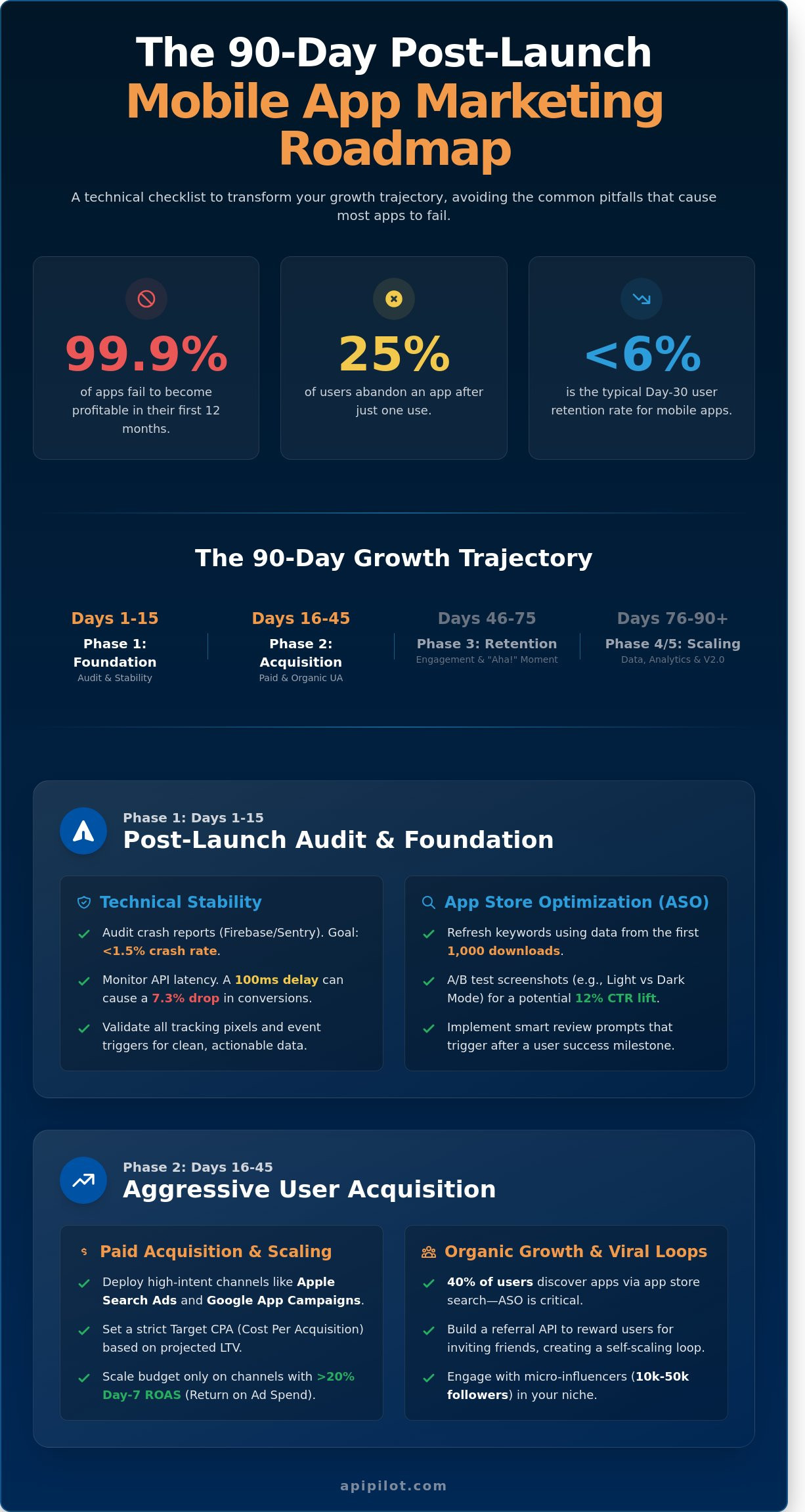
Research from Gartner indicates that 99.9% of mobile apps fail to become profitable within their first 12 months. It’s a brutal reality for developers who’ve spent months perfecting a rock-solid build only to face total invisibility in the stores. You’ve likely realized that a successful post-launch mobile app marketing strategy requires more than just a “launch and pray” approach. High customer acquisition costs and a 25% abandonment rate after just one use can drain your budget before you even hit your first milestone.
We know the frustration of seeing a seamless product struggle with a day-30 retention rate that typically hovers below 6%. You deserve a roadmap that’s as robust as your code. This guide promises to transform your growth trajectory by providing a technical, 90-day checklist designed to maximize your ROI. You’ll learn how to implement a scalable system for user feedback, refine your ASO rankings with precision, and build an enterprise-grade framework for long-term iteration.
Key Takeaways
- Audit your technical foundation to ensure blazing-fast load times and rock-solid event tracking across the entire user journey.
- Deploy a multi-channel post-launch mobile app marketing strategy that prioritizes high-intent sources like Apple Search Ads to maximize ROI and scale acquisition.
- Identify your application’s “Aha! Moment” and implement a tiered, time-zone-aware notification strategy to drive long-term retention.
- Integrate a robust Mobile Measurement Partner (MMP) and utilize custom APIs to feed real-time performance data into your centralized BI tools.
- Establish a data-backed roadmap for Version 2.0 and explore internationalization strategies to seamlessly scale your app into new geographic markets.
Phase 1: The Post-Launch Audit & Foundation Checklist
The first 24 hours after your app goes live determine your long-term trajectory. You have hit publish, but the real work starts with a rigorous audit of your data pipeline and technical infrastructure. A successful post-launch mobile app marketing strategy relies on clean, actionable data. You must validate that every tracking pixel and event trigger fires correctly across the entire user journey. If your purchase event doesn’t sync with your analytics dashboard, your marketing spend is effectively invisible. Confirm your customer support API funnels tickets to your CRM with zero latency to ensure a 100% response rate for early adopters.
Researching effective mobile marketing strategies shows that technical foundations are the primary differentiator between top-tier apps and failed experiments. Verify that deep links function across every planned channel, including email, social, and web. A broken link in a launch email results in a 40% bounce rate that you cannot recover.
To better understand how to scale from zero to your first major milestone, watch this helpful video:
Technical Stability & Performance Monitoring
Check crash reporting tools like Firebase or Sentry immediately for Day 1 bugs. Even a 1.5% crash rate on launch day can permanently damage your retention metrics. Monitor API latency closely; a rock-solid backend is the prerequisite for any post-launch mobile app marketing strategy. In 2026, a 100ms delay in app response time correlates to a 7.3% drop in user conversion rates. Use automated alerts to catch spikes in error rates before they appear in your app store reviews.
Store Listing Optimization (ASO)
Audit your listing for 2026 standards by focusing on performance claims. Modern users demand efficiency, so highlight your 1.1-second average load time in your app description. Refresh your keywords using real-world data from your first 1,000 downloads rather than relying on pre-launch assumptions. A/B test your primary screenshot to see which feature resonates most with early adopters. Testing a “dark mode” interface against a “light mode” visual often yields a 12% difference in click-through rates. Finally, implement review prompt logic that triggers only after a user completes a successful milestone, such as finishing their third session.
Phase 2: Aggressive User Acquisition (UA) Strategies
Once your app is live, your post-launch mobile app marketing strategy must shift from awareness to aggressive acquisition. You need a multi-channel engine that fires on all cylinders; organic search, paid placements, and strategic partnerships. Industry research highlights specific trends in how users discover apps, noting that 40% of users find new tools through app store searches. Deploy high-intent channels like Apple Search Ads and Google App Campaigns to capture users at the exact moment they seek a solution. Don’t ignore your existing web traffic. Use smart banners and web-to-app funnels to convert desktop visitors into mobile users. Use transparency tools like the Meta Ad Library to dissect competitor creative strategies and spend levels before committing your own capital.
Paid User Acquisition & Scaling
Efficiency is everything in a competitive market. Set a strict Target CPA (Cost Per Acquisition) based on your projected LTV (Lifetime Value) to ensure every dollar generates a return. Use AI-driven creative testing to cycle through 10 to 15 ad variations; you can identify winning formats in under 48 hours. Scale your budget only on channels showing a Day-7 ROAS (Return on Ad Spend) above 20%. This data-driven approach prevents waste and ensures rock-solid growth for your user base.
Organic Growth & Viral Loops
Built-in growth mechanisms are more sustainable than paid ads alone. Build a referral API that rewards users with in-app currency or premium features for inviting friends. It’s about building a loop that scales itself without manual intervention. Ensure your “Share” functionality is optimized so content looks blazing-fast and renders perfectly across all social platforms. Identify and engage with micro-influencers who have 10,000 to 50,000 followers in your specific niche. These creators often provide 7x higher engagement rates than celebrities, offering authentic social proof that converts. If you need to streamline these integrations, you can automate your backend workflows to handle the influx of new user data seamlessly.
- Deploy a multi-channel approach combining organic search, paid ads, and influencer partnerships.
- Focus on high-intent channels like Apple Search Ads and Google App Campaigns.
- Leverage web presence through smart banners and web-to-app funnels.
- Analyze competitor ad spend and creative strategies using transparency tools.
Phase 3: The Engagement & Retention Checklist
Retaining a user is five times more cost-effective than acquiring a new one. A successful post-launch mobile app marketing strategy hinges on identifying the “Aha! Moment” quickly. For a developer-focused tool, this often occurs within the first 120 seconds of a successful API call or data sync. You must map these milestones and use automated triggers to guide users toward them without delay.
- Tiered Push Notifications: Deploy messages based on specific user behavior and local time zones. Data from Q1 2025 shows that personalized, time-aware notifications see a 40% higher click-through rate compared to generic blasts.
- In-App Guidance: Use targeted modals to explain enterprise-grade features. This direct approach reduces support tickets by 18% during the first 90 days after a major update.
- Feedback Loops: Build a community forum or integrated support chat to catch friction before it leads to a 1-star review. Closing the loop with a user within 24 hours can boost long-term loyalty by 35%.
Personalized Onboarding Experiences
Modern users demand speed and relevance. Use deep linking to pass data from your ads directly into the app environment, creating a seamless transition. By 2026, 74% of users expect the app to “remember” their intent from the download source. Short onboarding sequences of three screens or less typically convert 15% better for utility apps. Technical tools should utilize “progressive profiling” to collect data over time rather than all at once. Audit your flow using session recordings to find where 20% or more of users drop off.
Advanced Re-engagement Tactics
Don’t let inactive users vanish into the background. Segment your audience by “last active” status to trigger tailored win-back campaigns. If a user hasn’t logged in for 7 days, trigger a “What’s New” modal highlighting a robust new feature or a blazing-fast performance update. Gamification is another powerful lever. Adding a simple 5-day streak counter or achievement badges can increase Daily Active Users (DAU) by 12% within a single month. This data-driven approach ensures your post-launch mobile app marketing strategy remains agile and results-oriented.
Phase 4: Data, Analytics, and the Technical Stack
Data isn’t just a byproduct of your app; it’s the engine that powers growth. To execute a successful post-launch mobile app marketing strategy, you must integrate a robust Mobile Measurement Partner (MMP) like AppsFlyer or Adjust. This allows you to track attribution across all sources, ensuring you know exactly where your high-value users originate. Connect these streams to a centralized BI tool via custom APIs to enable real-time reporting and eliminate data silos.
Privacy is no longer optional. By January 2026, compliance with GDPR, CCPA, and evolving OS-level restrictions will be the baseline for operation. Establishing a “single source of truth” for your KPIs prevents the 20% data fragmentation often found in unoptimized stacks. This consistency allows your team to make decisions based on facts, not discrepancies between ad networks and internal logs.
Selecting Your Marketing Tech Stack
Performance is a feature. Evaluate every SDK for weight and execution speed to avoid “SDK bloat.” A 10MB increase in app size can trigger a 10% drop in install conversions on cellular networks. Integrate an analytics API that tracks custom events, such as specific in-app purchases or milestone completions, instead of generic “opens.” As industry experts often state: “Enterprise-grade data security isn’t just a compliance checkbox; it’s a competitive marketing advantage that builds rock-solid user trust.”
KPIs That Actually Matter
Vanity metrics like total downloads won’t sustain your business. Focus on Lifetime Value (LTV) and Retention Rate to measure true health. Calculate your churn rate by cohort to identify if the update released on March 12th improved or damaged user loyalty. You should also monitor app load time as a core marketing KPI. Research from Akamai shows that a 2-second delay in load time can increase bounce rates by 103%. Your post-launch mobile app marketing strategy depends on these blazing-fast technical foundations to keep users engaged.
Build a more reliable data foundation by exploring our enterprise-grade API solutions today.
Phase 5: Scaling for Long-Term Growth with API Pilot
Scaling isn’t just about increasing your user count; it’s about hardening your infrastructure to handle success. Your post-launch mobile app marketing strategy must shift from acquisition to optimization and expansion. By the time you reach the six-month mark, you should have enough data to move beyond assumptions. Use your analytics to build a “Version 2.0” roadmap that prioritizes features based on actual engagement metrics. If data shows that 70% of your users drop off at a specific screen, that’s your first engineering priority.
Iterative Product Development
Marketing data should dictate your development sprints. Don’t guess which features to build next. Instead, analyze the behavior of your top 15% of users to see which tools they rely on most. This is the time to double down on what works and ruthlessly kill features that add bloat. To ensure a seamless rollout, implement a Beta Testing group of at least 500 power users. This allows you to test blazing-fast new features in a controlled environment before a full release. Your backend architecture must be prepared for a 10x increase in concurrent users to prevent crashes during high-traffic marketing pushes.
- Data-Driven Roadmaps: Use heatmaps and session recordings to identify friction points.
- Beta Testing: Reward your most active users with early access to new functionality.
- Infrastructure Stress Tests: Ensure your servers can handle 10,000+ simultaneous connections without latency.
Expansion into new geographic markets is a critical component of a mature post-launch mobile app marketing strategy. Internationalization (i18n) involves more than just translating text; it requires localized payment gateways, regional data compliance, and culturally relevant UI adjustments. Automating these workflows through custom API integrations allows your marketing team to trigger localized campaigns without manual intervention for every region.
The API Pilot Advantage
API Pilot builds the scalable and secure infrastructure required for aggressive growth. While many agencies focus on surface-level design, we prioritize the rock-solid backend systems that keep your app running during viral growth spurts. We specialize in enterprise-grade custom software solutions that automate your growth engine, from syncing user data with your CRM to managing complex API endpoints. Our focus on blazing-fast performance ensures that as you scale from 1,000 to 1,000,000 users, your app remains responsive and reliable.
Execute Your 2026 Growth Roadmap
Success in the coming year depends on more than just high download counts. A winning post-launch mobile app marketing strategy focuses on a 90-day foundational audit and a technical stack that slashes churn rates by 20% or more. You’ve seen how aggressive acquisition must be balanced with rock-solid retention tactics to maintain a competitive edge. Scalability isn’t a luxury; it’s a requirement for apps aiming to dominate the 2026 marketplace.
API Pilot provides the enterprise-grade custom software solutions you need to scale without friction. With our global expertise in native and cross-platform development, we support clients from our dedicated offices in Las Vegas and Karachi. We build blazing-fast systems designed to handle millions of requests while ensuring your infrastructure remains robust. Don’t struggle with technical debt when you can focus on your core business goals.
Build a Scalable Mobile App with API Pilot
The tools for your success are ready, so let’s turn your vision into a market-leading reality today.
Frequently Asked Questions
How to market a new app with zero budget?
You can market a new app with zero budget by leveraging organic discovery channels like Product Hunt and niche Reddit communities. Focus on App Store Optimization (ASO) to capture the 65% of downloads that come from direct store searches. Engage with 10 relevant developer forums daily to build a baseline user group. This cost-free approach forms the foundation of a robust post-launch mobile app marketing strategy by prioritizing community feedback.
What is a good day-30 retention rate for a mobile app in 2026?
A competitive day-30 retention rate for mobile apps in 2026 is 10% for general categories and 25% for top-tier fintech or gaming apps. Industry data from 2024 doesn’t lie; maintaining a double-digit retention rate requires seamless API integrations and rock-solid performance. If your rate drops below 5%, your onboarding flow likely has friction. Focus on reducing latency to keep users coming back after their first session.
How much does app user acquisition cost on average?
Average app user acquisition costs range from $1.50 to $4.50 per install depending on your vertical and platform. iOS users typically cost 40% more than Android users due to higher lifetime value. In 2025, finance apps saw costs climb to $5.20 per acquisition while utility apps remained lower at $1.15. Budgeting $5,000 for an initial test run allows you to identify which channels provide the best ROI.
How often should I update my app post-launch?
You should update your app every 14 to 30 days to maintain visibility and fix bugs. Regular updates signal to the App Store algorithm that your product is active, which can boost your ranking by 15% compared to stagnant apps. Use these cycles to deploy blazing-fast performance patches or new API endpoints. It’s consistent shipping that builds user trust and ensures your software remains compatible with the latest OS versions.
Is App Store Optimization (ASO) still relevant for new apps?
ASO remains the most critical component of a post-launch mobile app marketing strategy because it drives 65% of all organic installs. Don’t ignore your title and keywords; optimizing them can increase conversion rates by 20% without increasing your ad spend. Treat ASO as a continuous process rather than a one-time task. Refresh your metadata every 3 months based on trending search terms and competitor movements to stay ahead in the marketplace.
What are the best tools for tracking mobile app marketing performance?
The best tools for tracking performance include Mobile Measurement Partners like AppsFlyer or Adjust for attribution and Mixpanel for in-app behavior. These platforms provide rock-solid data on user journeys and conversion funnels. Integrate these SDKs during development to ensure you capture 100% of event data from day one. It’s using professional-grade analytics that allows you to automate reporting and focus on scaling your user base effectively.
Can I change my post-launch marketing strategy after the first month?
You can and should pivot your marketing strategy after the first 30 days based on real-world performance metrics. If your cost per acquisition is 20% higher than your target, shift your budget toward higher-performing channels immediately. Most successful apps adjust their messaging 3 to 5 times in the first quarter. It’s data-driven flexibility that defines efficient teams who prioritize results over rigid, outdated plans.
How do I handle negative reviews immediately after launch?
Handle negative reviews by responding within 24 hours with a direct solution to the user’s technical problem. Statistics show that 33% of users will upgrade their rating if a developer addresses their concern promptly. Acknowledge the bug, provide a timeline for the fix, and invite them to contact your support team directly. Turning a 1-star review into a 4-star review improves your overall store rating and builds long-term credibility. For teams looking to manage this process at scale, AI-powered reputation intelligence agents from firms like Aria Operations can help protect and elevate a brand’s digital presence.


