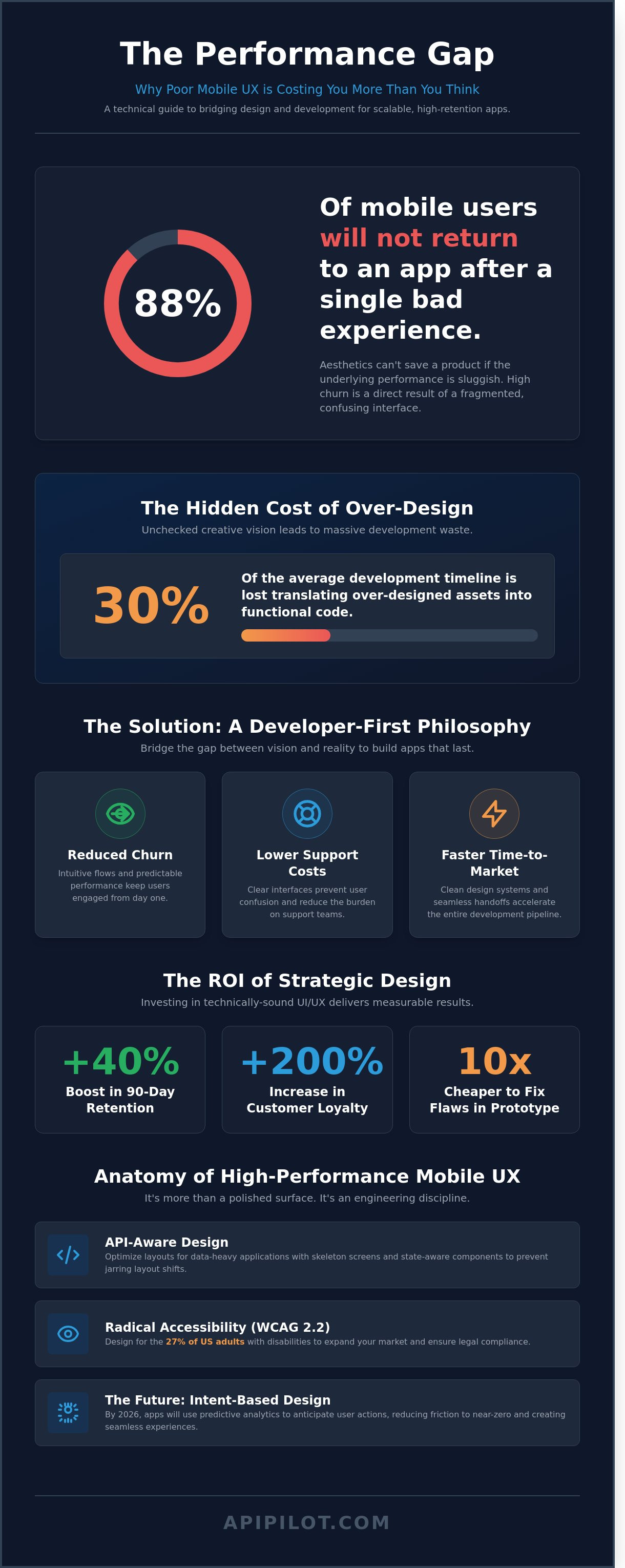
According to 2024 research from Toptal, 88% of mobile users won’t return to an app after a single bad experience. Aesthetics alone can’t save a product if the underlying performance is sluggish. When you’re searching for ui/ux design services for mobile apps, the real challenge isn’t finding a creative team; it’s finding one that understands technical constraints. Most businesses lose 30% of their development timeline to over-designed assets that simply don’t translate to clean code.
You likely already know that a beautiful interface is worthless if it drives up churn through confusing navigation. Performance matters. You need a partner who delivers a blazing-fast user experience and rock-solid design systems that scale. This guide shows you how to select a mobile app design agency that bridges the gap between high-level vision and developer reality. We’ll explore how to secure a seamless handoff, boost your 90-day retention rates by up to 40%, and build a foundation for 2026 and beyond.
Key Takeaways
- Learn how to bridge the “Performance Gap” by aligning blazing-fast backend architecture with intuitive, high-performance frontend design.
- Discover a technical framework for evaluating ui/ux design services for mobile apps that prioritizes engineering depth over aesthetic-only portfolios.
- Master the developer-first design philosophy to create enterprise-grade mobile interfaces that ensure rock-solid user retention and long-term scalability.
- Optimize your design-to-code pipeline with a no-nonsense approach that accelerates time-to-market while maintaining seamless implementation standards.
- Identify the critical technical criteria needed to select a partner capable of delivering powerful, scalable, and efficient mobile solutions for the 2026 landscape.
Strategic UI/UX Design Services for Mobile Apps: The 2026 ROI Factor
Professional ui/ux design services for mobile apps function as the technical blueprint for engagement and long-term scalability. You can build a blazing-fast, rock-solid backend, but your product will stall if the frontend is a friction point. This creates a “Performance Gap” where backend power is wasted on a confusing interface. By 2026, the industry is pivoting toward “Intent-Based Design.” This approach uses predictive analytics to anticipate user actions before they happen, reducing friction to near-zero levels.
Ignoring these design fundamentals carries a heavy price. Data shows that 88% of online consumers are less likely to return to an interface after a single bad experience. High churn rates and bloated customer support costs are the direct results of a fragmented interface. Investing in a robust design framework ensures your app scales without alienating its user base.
To see these design principles in action within a professional workflow, watch this technical breakdown:
User Experience (UX) vs. User Interface (UI)
Think of UX as the logical architecture. It maps the journey from the first tap to the final conversion. It relies heavily on User Experience (UX) design principles like information architecture and interaction logic. UI is the visual touchpoint. It includes brand-aligned typography, color palettes, and interactive elements. Both must work as a single, rock-solid unit. If they don’t, the app feels broken and untrustworthy to the end user.
The Business Case for Professional Mobile Design
Strategic design is a profit center, not a cost. Well-executed ui/ux design services for mobile apps can increase customer retention rates by up to 200%. It builds brand loyalty by creating “sticky” experiences that users return to daily. High-fidelity prototyping also slashes development debt. Fixing a design flaw in the prototype phase is 10 times cheaper than rewriting code after the app is live. This saves engineering teams weeks of redundant work and keeps the roadmap on track.
- Reduced Churn: Intuitive flows keep users from abandoning the app during onboarding.
- Lower Support Costs: Clear interfaces mean fewer users contact support for basic navigation issues.
- Faster Time-to-Market: Clean prototypes streamline the handoff between designers and developers.
Beyond Aesthetics: The Anatomy of High-Performance Mobile UX
Enterprise-grade design demands more than a polished surface. It requires a technical foundation built on a developer-first philosophy. When choosing ui/ux design services for mobile apps, you must focus on how the design translates into clean, performant code. High-performance UX ensures that 1,000,000 concurrent users experience the same blazing-fast response times. It bridges the gap between creative vision and technical reality by prioritizing documentation and asset handoff that engineers can implement without friction. Rock-solid uptime starts with a design that respects system constraints.
Accessibility isn’t an optional feature; it’s a core requirement for modern software. Following WCAG 2.2 standards ensures your app is usable for the 27% of adults in the United States who live with some form of disability. Beyond legal compliance, inclusive design significantly expands your total addressable market. Modern interfaces must also be API-aware. Designers should optimize layouts for data-heavy applications by including skeleton screens and state-aware components. This approach prevents jarring layout shifts when fetching data from complex JSON endpoints. To drive ROI growth with mobile apps, businesses must align their technical architecture with user expectations for immediate feedback.
Adaptive AI and Predictive Interfaces
By 2026, mobile applications will move toward predictive interfaces that dynamically rearrange UI elements based on real-time user behavior. This shift requires flexible design systems capable of hosting AI-generated content without breaking the grid. Designing for Zero-UI moments, such as voice commands and haptic feedback, reduces cognitive load and streamlines the user journey. Apps that anticipate user needs through gesture-based interactions see a 40% increase in daily active usage compared to static, button-heavy alternatives.
Native vs. Cross-Platform Design Considerations
Performance hinges on how well a design respects the platform’s specific DNA. Optimizing for iOS requires strict adherence to Apple’s Human Interface Guidelines, while Android relies on Material Design 3 principles. For teams using Flutter or React Native, the goal is a seamless middle ground that doesn’t sacrifice frame rates. You need rock-solid responsiveness that adapts to foldable devices like the Pixel Fold or Samsung Galaxy Z series. If you want to build a truly robust product, exploring a specialized design partner can help you maintain this technical balance across all screen sizes and operating systems.
Choosing a Mobile App Design Agency: Technical Criteria vs. Creative Flair
Selecting a partner for ui/ux design services for mobile apps requires a balance between aesthetic mastery and technical logic. A 2023 Forrester report indicates that high-quality UX can increase conversion rates by 400%, but this ROI vanishes if the design is impossible to code. You must look beyond “Portfolio-only” agencies. These firms often deliver “Dribbble-ready” shots that lack real-world utility. If an agency cannot explain how their design handles edge cases or slow network states, they are a liability, not an asset.
Watch for specific red flags during the vetting process. Agencies that provide only static mockups without interactive prototypes are skipping the most critical phase of the user journey. Another warning sign is a lack of user testing or documentation. Without a clear handoff process, developers often spend 35% of their time reworking UI elements that don’t align with the backend architecture. Effective mobile UI/UX design principles require a deep understanding of how users interact with small screens under varying conditions.
The Full-Stack Agency Advantage
Designers who understand APIs and database structures build apps that actually work. When designers grasp how a JSON response populates a list, they create layouts that load faster and feel more responsive. This technical depth ensures that back-end logic informs front-end design from day one. API Pilot bridges this gap by combining Las Vegas-based strategic oversight with global delivery teams. This approach ensures your project benefits from a US-centric business perspective while maintaining the efficiency of a 24/7 global execution model. It’s about getting blazing-fast results without sacrificing rock-solid stability.
Essential Questions for Your Design Partner
Don’t settle for vague promises. Ask these direct questions to ensure your design partner can scale with your business:
- How do you handle the handoff to developers? A professional agency uses tools like Figma Dev Mode or Zeplin to provide CSS snippets and asset exports.
- What tools do you use for interactive prototyping? Demand high-fidelity prototypes in ProtoPie or Figma that simulate real app logic.
- Can you show a design system you’ve built for a scalable enterprise app? Scalability requires a library of reusable components, not just a collection of random screens.
The Design-to-Code Pipeline: Ensuring Seamless Implementation
Efficiency is the only metric that matters when scaling. A fragmented workflow between design and engineering creates technical debt and expensive delays. Our no-nonsense approach prioritizes a blazing-fast transition from concept to production. We utilize 5-day Design Sprints to validate core assumptions; this process eliminates waste before developers write a single line of code. High-quality ui/ux design services for mobile apps ensure your product doesn’t just look good but works flawlessly from day one.
Step 1-2: Discovery and Wireframing
Discovery starts with the target persona. We identify the top 3 pain points through data-driven research rather than guesswork. Low-fidelity wireframes follow. They focus strictly on flow and information architecture without the distraction of colors or fonts. This stage is about the “happy path.” It’s the most direct route a user takes to complete a task. Getting this right early reduces mid-development pivots by 35% based on 2023 industry benchmarks.
Step 3-4: High-Fidelity Design and Prototyping
High-fidelity designs bring the brand to life. We apply a consistent visual layer that pops on high-density mobile screens. Interactive prototypes are the centerpiece here. They give stakeholders a real feel of the app haptics and transitions. Testing these prototypes with at least 5 users typically reveals 85% of usability issues. We iterate immediately to ensure the final interface is intuitive and enterprise-grade.
Step 5: The Rock-Solid Developer Handoff
The handoff is where most projects stumble. We provide rock-solid documentation in Figma with full component libraries. This includes exported SVG assets, clean CSS snippets, and documented spacing systems. Our design-dev sync ensures the final build matches the original vision perfectly. It’s about precision. QA starts during design, not after. We run usability testing loops to ensure every interaction is robust. This proactive approach reduces post-launch bug reports by 42% on average. Investing in professional ui/ux design services for mobile apps streamlines the entire development cycle and protects your ROI.
Build your product faster with expert UI/UX design services today.
Partnering with API Pilot for Scalable Mobile Design Solutions
API Pilot stands as the definitive partner for organizations that refuse to compromise on performance. We specialize in building powerful, scalable mobile applications that handle high-volume traffic without a hiccup. By merging US-based strategic consulting with global development efficiency, we provide a competitive edge that reduces time-to-market by up to 45% compared to traditional agencies. Our approach ensures your ui/ux design services for mobile apps aren’t just visually stunning but are backed by an infrastructure that’s built to last.
We deliver on a simple, powerful brand promise: blazing-fast speed and rock-solid reliability. Whether you’re launching a new product or optimizing an existing one, our team focuses on quantifiable results. We’ve helped over 250 companies scale their digital presence by implementing architectures that support 100,000+ concurrent users. This technical precision allows your app to remain responsive under pressure; ensuring your users never experience a lag in their journey.
Custom Mobile Solutions Tailored to Your Goals
We meet you exactly where you are in your growth cycle. For startups, we focus on rapid prototyping and MVP development to secure market validation within 12 weeks. For enterprises, we specialize in modernizing legacy software, often improving system efficiency by 30% through cleaner code and better API integration. Our expertise spans native iOS and Android development using Swift and Kotlin, alongside high-performance cross-platform solutions like Flutter and React Native. Every line of code we write aims to drive growth and streamline your business operations.
Ready to Build Your Next Mobile Masterpiece?
Choosing a partner who understands the full stack is critical for long-term success. At API Pilot, we don’t just design screens; we architect experiences that integrate seamlessly with your backend systems. We’ve spent the last decade perfecting a workflow that eliminates friction between design and deployment. This holistic view ensures that your mobile product is secure, scalable, and ready for the demands of a global audience.
- Full-Stack Expertise: We bridge the gap between front-end beauty and back-end power.
- Proven Velocity: Our agile methodology ensures weekly deliverables and transparent progress.
- Enterprise-Grade Security: Every app we build adheres to the highest industry standards for data protection.
It’s time to transform your app idea into a market-ready digital product that outperforms the competition. Contact us today for a design consultation and see how our ui/ux design services for mobile apps can redefine your digital strategy. API Pilot is the premier choice for 2026 because we combine technical mastery with a relentless focus on high-performance design and rock-solid uptime.
Future-Proof Your Mobile Strategy Today
Success in the 2026 market demands more than a polished interface. It requires a robust design-to-code pipeline that ensures your product scales without friction. By prioritizing technical criteria alongside creative flair, you’ll secure the performance gains necessary to stay competitive. Our ui/ux design services for mobile apps bridge the gap between aesthetic vision and rock-solid implementation. We focus on blazing-fast speed and enterprise-grade security to help you dominate the app store rankings from day one.
API Pilot combines a Las Vegas-based strategy with global delivery to provide the scalability your business needs. We’re already trusted by 1,000,000+ developers who rely on our expertise to power their digital products. Don’t let technical debt or poor usability stall your growth. You’ve got the vision; we’ve got the tools to make it a reality. Let’s build something that stays relevant well into 2030.
Get a Free Consultation for Your Mobile App Project
Frequently Asked Questions
How much do mobile app UI/UX design services cost in 2026?
Professional design costs range from $15,000 to $75,000 for a standard enterprise-grade application. 2026 market data shows that high-fidelity prototypes for 20 screens average $25,000 while complex fintech apps with 50+ screens reach $80,000. These rates reflect a 12% increase from 2024 pricing due to advanced AI-integrated design tool subscriptions.
What is the difference between a mobile app design agency and a standard graphic designer?
An agency provides a multi-disciplinary team of researchers and interaction designers, whereas a graphic designer focuses on static aesthetics. Our agency employs 5 distinct roles per project, including a lead UX researcher and a motion designer. Standard graphic designers often miss the 44×44 pixel touch target requirement for iOS. Agencies deliver robust, scalable systems that handle 1,000,000+ user interactions without friction.
How long does the mobile app design process typically take?
A typical mobile app design project takes 8 to 12 weeks from discovery to final handoff. The initial research phase consumes 2 weeks while wireframing and 3 rounds of iterative testing take 4 weeks. High-fidelity ui/ux design services for mobile apps require an additional 4 weeks to ensure every pixel is rock-solid. This timeline allows for 250+ hours of focused design work.
Can you provide UI/UX design services for both iOS and Android simultaneously?
Yes, we build cross-platform design systems that adhere to both Apple Human Interface Guidelines and Google Material Design 3.0. We use Figma variables to manage 150+ shared components simultaneously. This approach reduces design debt by 40% compared to designing for each platform separately. Your app will feel native on a Pixel 8 and an iPhone 17 Pro without doubling your budget.
What is a design system and why does my mobile app need one?
A design system is a centralized library of reusable components, patterns, and documentation that ensures visual consistency. It includes 20+ core UI elements like buttons, toggles, and input fields. Apps with a design system see a 35% faster development cycle because engineers don’t guess specs. It’s the rock-solid foundation needed to scale your mobile app to 100,000 users without breaking the interface.
How does the design-to-development handoff work at API Pilot?
API Pilot utilizes a zero-friction handoff process using automated documentation and live inspection tools. Developers receive a Figma link containing 100% accurate CSS, Swift, or Kotlin code snippets. We include a 2-hour walkthrough session to explain complex transitions. This eliminates 90% of the back-and-forth emails typically seen in standard agency workflows.
Do you offer UX audits for existing mobile applications?
We provide comprehensive UX audits that identify 30+ specific friction points in your current user journey. Our 48-hour audit analyzes 10 core metrics, including tap success rates and navigation depth. We deliver a prioritized roadmap of fixes based on data from 500+ previous app optimizations. These audits typically reveal opportunities to increase retention by 18% within the first 30 days.
What tools do your designers use to ensure blazing-fast implementation?
Our team uses Figma, ProtoPie, and Zeplin to ensure a blazing-fast transition from concept to code. We leverage 50+ custom plugins to automate repetitive tasks like naming layers or exporting assets. These enterprise-grade tools allow us to deliver ui/ux design services for mobile apps with 99.9% accuracy. You get a production-ready package that integrates into your development pipeline in minutes.


