
Scope creep. Hidden fees. Budget overruns. These aren’t just buzzwords; they are the financial risks that can derail even the most promising software project before it launches. The root of this anxiety often lies in a single, critical decision: choosing from the various custom software development pricing models. Navigating options like Fixed-Price, Time & Materials, or a Dedicated Team can feel like a high-stakes gamble, leaving you to wonder which path truly protects your investment.
Planning a project like this? See how our custom software development services work, from a free scope to a fixed quote in 48 hours.
This 2025 guide is engineered to eliminate that uncertainty. We deliver a direct, no-nonsense breakdown of the industry’s most robust pricing structures, detailing the pros, cons, and ideal project scenarios for each. You will gain a clear, actionable understanding of how each model impacts your timeline, flexibility, and total cost of ownership, empowering you to move beyond confusion and toward strategic decision-making.
By the end of this article, you will have the clarity to evaluate vendor proposals with confidence, select a model that aligns perfectly with your goals, and forge a rock-solid, transparent financial partnership. Let’s build a predictable budget and set your project up for success.
The Two Foundational Models: Fixed Price vs. Time & Materials
Navigating custom software development pricing models almost always begins with two foundational approaches: Fixed Price and Time & Materials (T&M). The choice between them represents a core trade-off between budget predictability and project flexibility. There is no single “best” model; the optimal choice is dictated entirely by your project’s scope, clarity, and complexity.
Think of it like construction. A Fixed Price model is like building a new house from a detailed, unchangeable blueprint-you know the exact cost upfront. A Time & Materials model is like renovating an old house room-by-room-you have a general goal, but you adapt and pay for labor and materials as you uncover challenges and new ideas.
To better understand this core dynamic, the following video provides a high-level overview:
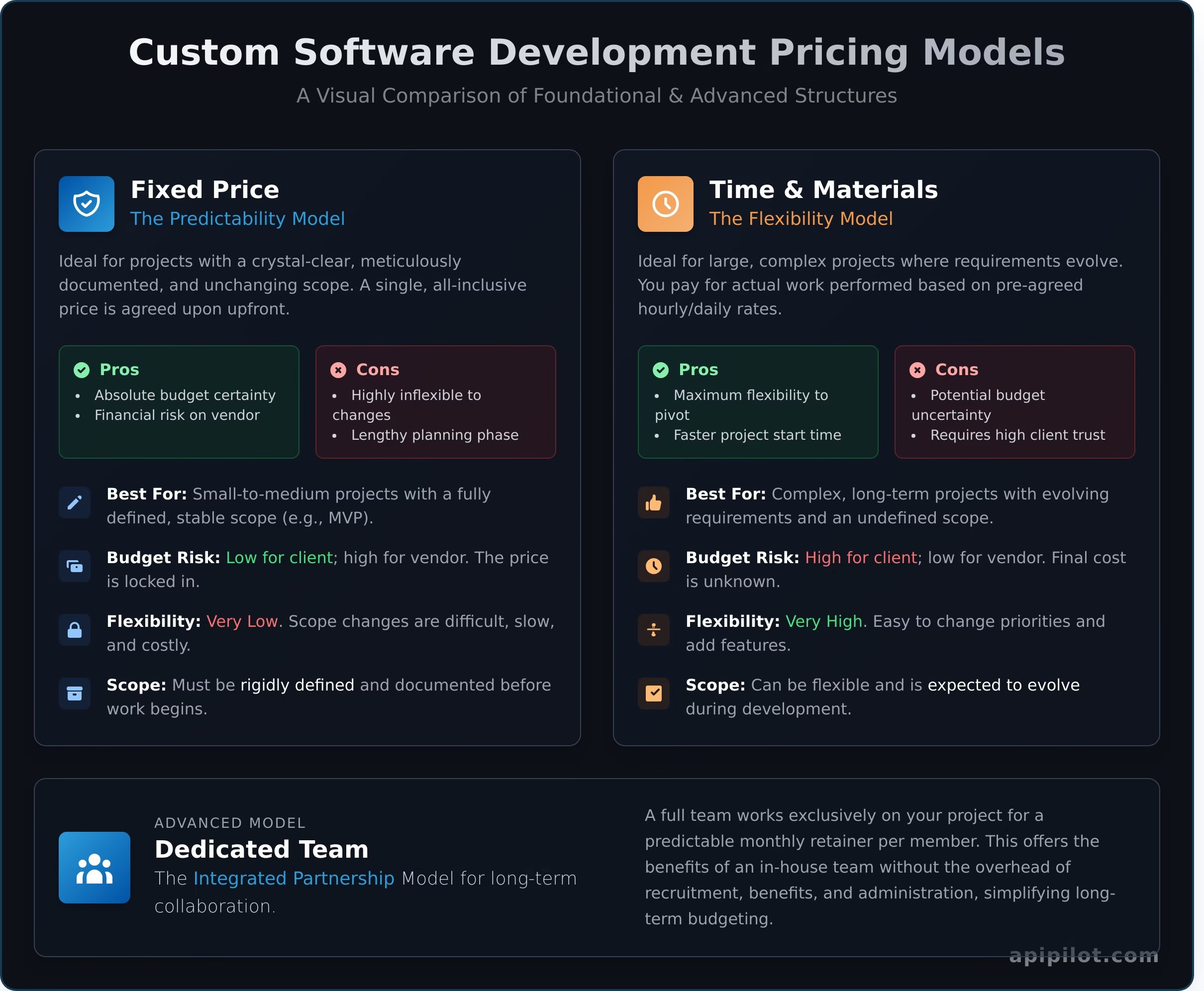
Fixed Price: The Predictability Model
This model is engineered for projects with a crystal-clear, meticulously documented, and unchanging scope. The development partner provides a single, all-inclusive price for the entire project. This is the go-to for smaller, well-defined applications or MVPs where requirements are set in stone.
- Pros: Absolute budget certainty. The financial risk is transferred almost entirely to the vendor, offering you peace of mind.
- Cons: Highly inflexible to changes. The upfront planning phase can be lengthy and exhaustive. There’s also a risk that the vendor may cut corners to protect their profit margin if unforeseen issues arise.
Time & Materials (T&M): The Flexibility Model
Ideal for large, complex, and long-term projects, the T&M model thrives on agility. Instead of a fixed cost, you pay for the actual work performed based on pre-agreed hourly or daily rates. This structure is the backbone of Agile development, where requirements are expected to evolve. As a widely recognized contract type, Time and Materials (T&M) allows for a dynamic process where features can be added or modified in response to user feedback and market changes.
- Pros: Maximum flexibility to adapt and pivot. Projects can start faster without exhaustive initial planning. The process is transparent, as you typically see detailed reports of time spent.
- Cons: Potential for budget unpredictability. This model requires a high degree of trust in your development partner and significant involvement from your team to manage scope and priorities.
At a Glance: Fixed Price vs. T&M Comparison
| Aspect | Fixed Price Model | Time & Materials Model |
|---|---|---|
| Best For | Small-to-medium projects with a fully defined, stable scope (e.g., MVP, simple app). | Complex, long-term projects with evolving requirements and an undefined final scope. |
| Budget Risk | Low for client; high for vendor. The price is locked in. | High for client; low for vendor. The final cost is unknown. |
| Flexibility | Very low. Scope changes are difficult, slow, and costly to implement. | Very high. Easy to change priorities, add features, or pivot the project direction. |
| Scope | Must be rigidly defined and documented before work begins. | Can be flexible and is expected to evolve throughout the development lifecycle. |
| Client Involvement | Heavy during the initial planning phase, then minimal until UAT. | Consistently high. Requires regular feedback and decision-making to guide the project. |
Advanced & Hybrid Models for Modern Agile Projects
While basic pricing structures have their place, they often lack the flexibility required for agile methodologies and long-term, evolving projects. Experienced development agencies have engineered advanced and hybrid custom software development pricing models to address these limitations. These structures are built for collaboration, transparency, and aligning the development team’s success with your business outcomes.
Dedicated Team: The Integrated Partnership Model
This model provides you with a full, dedicated team of developers, QA engineers, and project managers who work exclusively on your project. Pricing is a straightforward monthly retainer per team member, offering predictable, recurring costs. It’s the equivalent of having a robust in-house team without the immense overhead of recruitment, benefits, and administration. This model simplifies long-term budgeting and helps businesses accurately forecast their investment, moving beyond simple project fees to a clearer understanding of the Total Cost of Ownership (TCO) for their software asset.
- Best for: Long-term projects (12+ months), products requiring deep domain expertise, and businesses needing to scale their development capacity quickly.
- Key Benefit: Maximum control, deep integration, and unmatched team cohesion.
Milestone-Based: The Performance-Driven Model
A sophisticated evolution of the Fixed Price model, the Milestone-Based approach ties payments directly to the completion of specific, pre-defined deliverables. The project is broken down into logical phases or milestones-such as “User Authentication Complete” or “API Integration Deployed”-and payment is issued only upon successful delivery and acceptance of each stage. This significantly de-risks the investment for the client by ensuring tangible progress before funds are released.
- Best for: Medium-to-large projects with a clear, sequential roadmap and well-defined phases.
- Key Benefit: Mitigates financial risk and ensures a performance-driven engagement.
Value-Based Pricing: The True ROI-Focused Approach
This is the most strategic of all custom software development pricing models. Instead of billing for time or features, the price is determined by the measurable business value the software will deliver. For example, if a new automation system is projected to save your company $1 million annually, the development cost might be set at $200,000, regardless of the hours worked. This model requires deep trust, a transparent partnership, and a rock-solid method for quantifying business impact, making it the ultimate alignment of interests between client and developer.
- Best for: Strategic, long-term partnerships where the software provides a clear and significant competitive advantage or ROI.
- Key Benefit: Directly ties the cost of development to its financial success and business impact.
How to Choose the Right Pricing Model: A Decision Framework
Understanding the models is the first step. Now, let’s translate theory into a practical decision. This framework is designed to help you analyze your project’s unique DNA, empowering you to select the optimal model before engaging with a development partner. Remember, the goal isn’t to find the “best” model, but the “best fit” for your specific requirements, timeline, and budget.
Step 1: Assess Your Project’s Scope and Clarity
The clarity of your project scope is the most critical factor. A well-defined, documented roadmap with minimal expected changes points toward predictable models, while an exploratory project demands agility.
- Fully Defined Scope: If your requirements, features, and user flows are documented in detail, a Fixed Price or Milestone model offers predictability and minimizes financial risk.
- Evolving Scope: For an MVP, a complex enterprise system, or any project where requirements will be refined during development, the Time & Materials or Dedicated Team models provide the necessary flexibility.
Step 2: Evaluate Your Need for Control and Flexibility
Your desired level of involvement and need for agility directly influence model selection. A hands-off approach suits a different model than one requiring daily collaboration and the ability to pivot quickly.
- High Control & Flexibility: Choose Time & Materials. This model allows you to reprioritize features, manage the backlog directly, and adapt to market feedback in real-time.
- Low Involvement (“Set & Forget”): A Fixed Price model is ideal. You agree on the outcome upfront and let the development team execute with minimal day-to-day oversight from your side.
Step 3: Match the Model to Your Budgeting Process
Your internal financial processes are a major constraint. Aligning the pricing model with how your organization allocates funds prevents friction and ensures project viability from the start.
- Strict, Pre-Approved Budget: The Fixed Price model is the most straightforward option, providing a single, predictable number for approval.
- Monthly/Operational Budget: T&M and Dedicated Team models align perfectly with a predictable monthly burn rate, treating development as an operational expense.
- ROI-Driven Budget: The Value-Based model is an advanced approach that ties cost directly to business outcomes. As detailed in expert analysis from McKinsey on software pricing strategies, linking price to value is a powerful lever for growth, making it a key consideration in modern custom software development pricing models.
Decision Matrix: Project Type vs. Ideal Pricing Model
Beyond the Model: Uncovering the Total Cost of Ownership
Selecting from various custom software development pricing models is a critical first step, but it doesn’t reveal the full financial picture. The lowest hourly rate often masks significant downstream expenses. A truly effective development partner understands that the initial build is just one component of the Total Cost of Ownership (TCO). They build trust not with a lowball quote, but with a transparent breakdown of all anticipated costs.
Failing to account for these factors leads to budget overruns and project friction. Here’s what a comprehensive budget includes beyond the core development hours.
Budgeting for ‘Non-Coding’ Essentials
Robust software isn’t just written; it’s engineered. The most critical work often happens away from the code editor, ensuring the final product is strategic, stable, and delivered efficiently.
- Discovery & Strategy: This initial phase involves workshops, requirements gathering, and technical architecture planning. It’s the blueprint that prevents costly rebuilds and ensures the software solves the right business problem.
- Project Management: The overhead for keeping development on track, managing resources, and facilitating clear communication. Effective PM is the engine that drives a project toward its milestones on time and on budget.
- Quality Assurance (QA): A dedicated process for testing, bug fixing, and performance validation. QA isn’t an expense; it’s an investment in rock-solid reliability and a positive user experience.
The Long-Term Costs: Post-Launch Investments
Your software’s journey begins at launch. Budgeting for its lifecycle is essential for long-term success and ROI.
- Maintenance & Support: Ongoing costs for security patches, dependency updates, and bug fixes to ensure the application remains secure and operational.
- Hosting & Infrastructure: Server, database, and CDN costs that scale with user traffic. A competent partner will architect a cost-efficient, scalable infrastructure from day one.
- Future Enhancements: No software is ever “finished.” Set aside a budget for Version 2.0, new features, and user-requested improvements to maintain a competitive edge.
How a Transparent Partner Mitigates Financial Risk
A trustworthy development firm demystifies the costs associated with custom software development pricing models. They operate as a strategic partner, not just a vendor. Look for a team that:
- Provides detailed proposals, not vague one-page quotes. The proposal should break down hours by task, role, and project phase.
- Delivers clear reports on time and budget utilization, giving you full visibility into project velocity and spend.
- Proactively discusses the budget implications of any scope changes, ensuring you can make informed decisions without surprises.
Ready to build with a partner who values clarity and predictability? Get a transparent, no-surprise quote from API Pilot.
Navigate Your Pricing Strategy with Confidence
Selecting the optimal model is a strategic decision that shapes your project’s trajectory. Understanding the nuances of custom software development pricing models is critical. As we’ve explored, the choice extends beyond the traditional Fixed Price vs. Time & Materials debate, with hybrid approaches offering the flexibility required for modern agile cycles. The most effective framework considers not just the initial estimate, but the total cost of ownership, aligning perfectly with your project scope and long-term goals.
The right partner makes this decision straightforward. At APIpilot, we build partnerships on a foundation of transparency. We deliver exceptionally detailed project proposals and champion flexible engagement models tailored to your needs. By leveraging a global team, we provide optimized blended rates that deliver maximum value without compromising on quality or performance.
Ready to move forward with clarity? Schedule a free consultation to discuss your project’s pricing with our experts. Let’s build a powerful and predictable roadmap for your success.
Frequently Asked Questions
What is the most common pricing model for a startup building an MVP?
Startups often favor a Time & Materials (T&M) model for MVP development due to its inherent flexibility. This approach allows for rapid iteration and pivoting based on crucial early user feedback without needing to renegotiate a fixed scope. Alternatively, a Fixed-Price model can work if the MVP scope is exceptionally well-defined and granular. However, T&M generally provides the agility required to navigate the uncertainty of building a new product and achieve product-market fit efficiently.
How does agile development work with a fixed-price contract?
Combining agile development with a fixed-price contract is challenging but achievable through a “Fixed-Price, Scope-Flexible” framework. In this model, the overall budget and timeline are fixed, but the feature backlog is rigorously prioritized. Development proceeds in sprints, focusing on the highest-value features first. If the budget is exhausted before all features are built, lower-priority items are simply left out of the release. This approach requires robust project management and transparent communication.
Can you switch pricing models in the middle of a project?
Yes, switching custom software development pricing models mid-project is possible but demands a formal contract amendment agreed upon by both parties. A typical scenario involves completing a fixed-price discovery phase to establish a clear project scope, then transitioning to a Time & Materials model for the main development. This shift provides greater flexibility once requirements are well-understood. The key is to meticulously document the new terms, rates, and responsibilities to ensure continued alignment.
What are typical hourly rates for custom software development in 2025?
Hourly rates for custom software development in 2025 vary significantly based on geographic location and developer expertise. In North America, expect rates from $120 to over $250 per hour. Western European developers typically charge between $80 and $180, while rates in Eastern Europe are more competitive, from $40 to $75. In regions like Asia and Latin America, rates can range from $25 to $60. These figures are influenced by the complexity of the tech stack and the agency’s reputation.
How do you control costs in a Time & Materials (T&M) project?
Effective cost control in a Time & Materials project hinges on rigorous project management and transparent communication. Implement budget caps for sprints or project milestones to create financial checkpoints. Insist on detailed, regular timesheet reporting and maintain a strictly prioritized backlog to ensure engineering efforts are focused on high-impact features. Frequent demos and review sessions are critical for monitoring progress, preventing scope creep, and ensuring the project remains on a predictable financial track.
What should be included in a custom software development contract?
A robust custom software development contract must be comprehensive to mitigate risk. It should include a detailed Scope of Work (SOW), defining all deliverables and technical specifications. The document must clearly outline the agreed-upon pricing model, payment schedule, and invoicing procedures. Other critical components include clauses on Intellectual Property (IP) ownership, project timelines, confidentiality (NDA), acceptance criteria, and procedures for dispute resolution. A well-defined contract is the foundation for a successful partnership.