
You have a powerful app idea, but one critical question stands in the way: how much will it actually cost? Vague quotes, complex technical jargon, and the fear of a ballooning budget can paralyze any project before it starts. Asking ‘how much does it cost to build an app’ often feels like asking ‘how long is a piece of string?’ The answer is always ‘it depends’-an unhelpful response when you’re trying to secure funding or determine if your vision is financially viable.
This guide is part of our mobile app development services resources, which explain how we plan, build and support this kind of work.
This guide cuts through that ambiguity. We provide a data-driven, no-nonsense breakdown of app development costs for 2025. You will get realistic price ranges based on app complexity, understand the key technical factors that drive the final price-from feature sets and API integrations to platform choices-and learn how to build a rock-solid budget that accounts for post-launch maintenance. Forget the guesswork. By the end of this article, you will have the clarity needed to confidently evaluate developer quotes and move your project from concept to code.
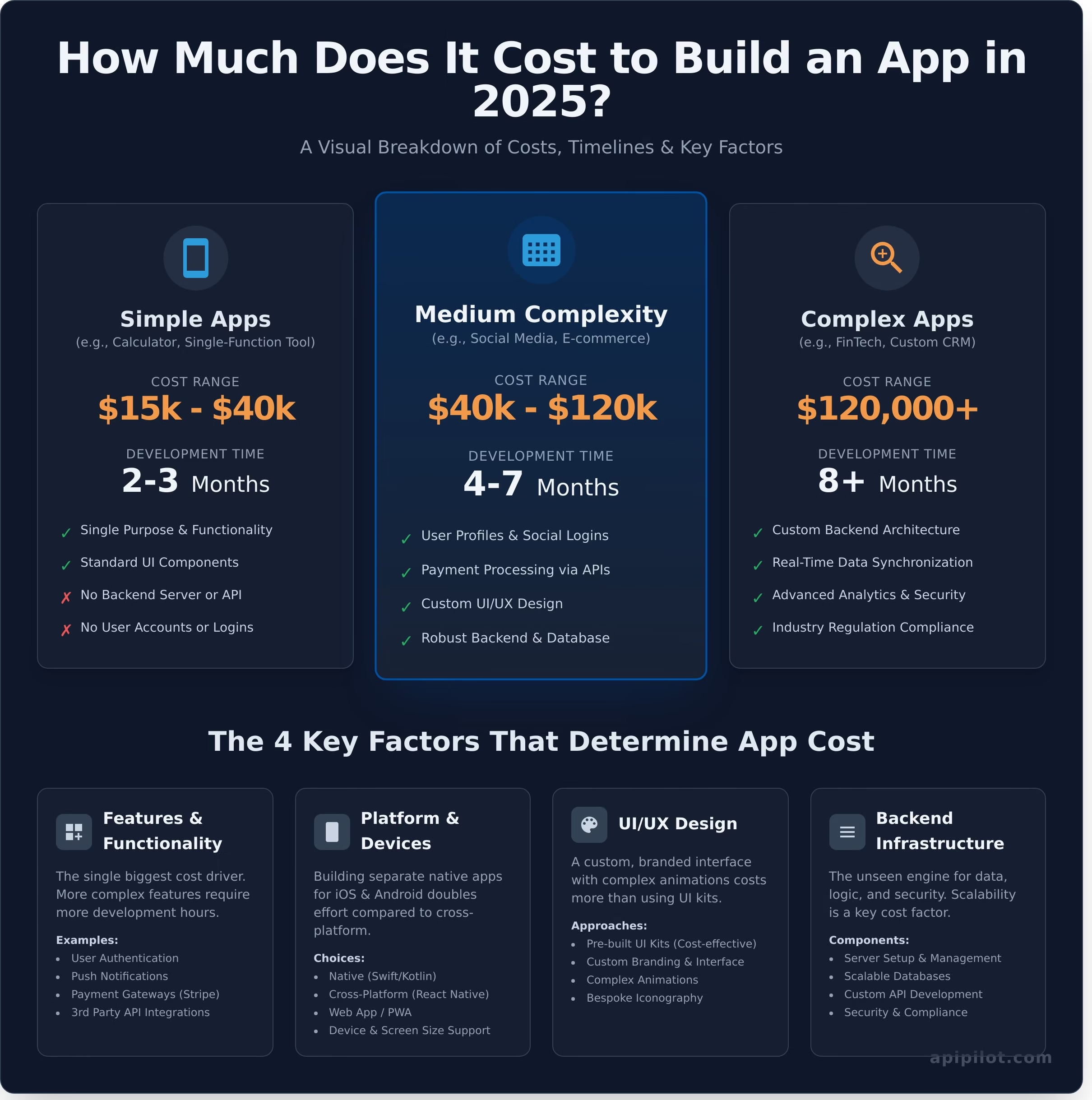
The Short Answer: App Cost Ranges by Complexity
When asking how much does it cost to build an app, the most accurate answer is always: it depends on complexity. To provide a clear, scannable starting point, the table below outlines the typical cost and timeline ranges you can expect in 2026. These are high-level estimates designed to give you a pragmatic baseline for your project planning.
For a visual breakdown of these cost factors, the following video provides a clear overview:
Ultimately, cost is a direct function of time-the more hours developers, designers, and project managers invest, the higher the final price. This time is dictated by the number of features, the complexity of the backend infrastructure, and the necessity for third-party API integrations. Understanding the mobile app development process from discovery to deployment is critical for accurately forecasting your budget. The remainder of this article will break down these factors in detail.
Simple Apps (e.g., Calculator, Single-Function Tool)
- Cost Range: $15,000 – $40,000
- Development Time: 2-3 months
Simple apps represent the most basic tier. They typically serve a single purpose with a standard UI and require no backend server or network connectivity. Characteristics include a limited feature set, no user accounts, and a focus on core functionality for a single platform. Examples include a basic unit converter, a simple to-do list, or a local event listing app that displays static information.
Medium Complexity Apps (e.g., Social Media, E-commerce)
- Cost Range: $40,000 – $120,000
- Development Time: 4-7 months
This is the most common category for consumer and business apps. A medium complexity app includes features like user profiles, social media logins, payment processing via APIs, and a custom UI/UX. It requires a robust backend server to manage data, user interactions, and push notifications. A basic version of a food delivery app or a social networking platform are prime examples.
Complex, Enterprise-Level Apps (e.g., FinTech, Custom CRM)
- Cost Range: $120,000+
- Development Time: 8+ months
Complex applications are built for massive scalability, rock-solid security, and intricate functionality. These projects often involve custom backend architecture, real-time data synchronization, advanced analytics, and compliance with industry regulations (like in FinTech). The development is extensive, requiring large, specialized teams to build and maintain a seamless, multi-platform solution like a banking app or a large-scale enterprise management tool.
The 7 Key Factors That Determine App Development Costs
The vague “it depends” answer to how much does it cost to build an app is frustrating but accurate. This section transforms that ambiguity into actionable insight. Think of building an app like constructing a house: features are the rooms, design is the architecture, and the backend is the foundation and plumbing. Every decision, from a simple button to a complex algorithm, directly impacts the final price tag. Here are the core factors you need to control.
1. Features & Functionality
This is the single biggest cost driver. A feature that seems simple on the surface, like user login, requires a secure backend, database integration, password recovery logic, and social sign-on API calls. The scope of your feature set should be defined by rigorous market research and analysis to ensure you’re building what users actually need, avoiding costly, unused functionality. Common cost-intensive features include:
- User Authentication & Profiles
- Push Notifications
- Payment Gateway Integration (e.g., Stripe)
- Third-Party API Integrations
- Admin Panels & Content Management
2. Platform & Devices (iOS, Android, Web)
Choosing your target platform has major cost implications. Building separate, native apps for iOS (Swift) and Android (Kotlin) delivers the best performance and user experience but doubles development effort. Cross-platform frameworks like React Native or Flutter reduce costs with a single codebase but may present limitations for graphically-intensive or hardware-dependent apps. Furthermore, supporting a wide range of devices, screen sizes, and older OS versions adds significant testing and development overhead.
3. UI/UX Design Complexity
A seamless user interface (UI) and user experience (UX) are non-negotiable for success. Using pre-built UI kits is cost-effective for MVPs, while a fully custom, branded interface with complex animations and bespoke iconography requires a significant design investment. While it may seem like a high upfront cost, investing in a powerful UX is critical for reducing user churn and increasing long-term engagement and profitability.
4. Backend Infrastructure & APIs
The backend is the unseen infrastructure that powers your application, handling all data storage, business logic, security, and server-side operations. This involves setting up servers, architecting scalable databases, and developing the custom APIs that allow the front-end app to function. Building a robust backend that can scale seamlessly from 100 to 1 million active users requires sophisticated engineering and is a foundational component of your budget.
Who Builds Your App? How Team Structure Impacts Price
Beyond features and complexity, the single largest variable determining how much does it cost to build an app is the team you hire. The talent, structure, and location of your development team directly translate to your project’s final price tag. Choosing the right model is a critical balance between budget, control, and expertise.
Hiring Models: Freelancer vs. Agency vs. In-House
Your choice of hiring model presents a clear trade-off between cost and management overhead. Each has distinct financial implications:
- Freelancers: Offer the lowest hourly rates but require you to act as the project manager, sourcing and coordinating individual specialists. This model carries higher risk and management burden.
- Development Agency: A higher-cost option that provides a pre-vetted, multi-disciplinary team, including project management. This is an efficient, turn-key solution for getting a product to market without internal hiring.
- In-House Team: The most expensive route, involving salaries, benefits, and long-term overhead. It provides maximum control and is ideal for long-term, core business products.
The Roles on a Professional Development Team
Building an enterprise-grade application is not a one-person job. A cohesive team of specialists is essential for a seamless and successful launch, and their combined expertise is a key factor in The High Cost Of App Development. A standard professional team includes:
- Project Manager: The strategic lead who ensures the project stays on schedule and within budget.
- UI/UX Designer: Architects the user journey, wireframes, and visual interface to create an intuitive and engaging experience.
- Developers: The engineers who write the code. This typically includes frontend (user-facing), backend (server-side), and mobile (iOS/Android) specialists.
- QA Engineer: Rigorously tests the application to identify and document bugs before they impact users.
The Impact of Geographic Location on Hourly Rates
Developer rates vary dramatically worldwide. This geographic arbitrage is a major factor in determining your final app building cost. Here is a general breakdown of average hourly rates for 2026:
At API Pilot, we leverage a global talent model. By building expert teams across different geographic regions, we offer a “blended rate” that provides access to world-class developers without the premium costs of North American or Western European markets. This delivers a powerful combination of quality and cost-efficiency for our clients.
The Hidden Costs: Budgeting Beyond Initial Development
Calculating the initial development budget is a critical first step, but the launch of your app is the beginning, not the end, of your investment. A common oversight is failing to account for the ongoing operational costs required to keep an application functional, secure, and competitive. Factoring these expenses into your financial model is essential for understanding how much does it cost to build an app over its entire lifecycle.
App Maintenance and Updates
Consider app maintenance a non-negotiable operational expense. A robust industry standard is to budget 15-20% of the initial development cost annually for maintenance. This budget covers critical activities that ensure a seamless user experience and protect your investment.
- Core Maintenance: This includes fixing bugs discovered post-launch, patching security vulnerabilities, and optimizing code for performance.
- OS Compatibility: Each year brings new operating systems like iOS 18 and Android 15. Your app will require updates to ensure it remains functional and can leverage new platform features.
- Minor Enhancements: Small, iterative feature updates based on user feedback keep your app relevant and engaging without requiring a full development cycle.
Server Hosting and Third-Party Services
Modern applications rarely exist in a vacuum; they rely on a robust backend infrastructure and external services. These recurring costs are directly tied to your app’s performance and scalability. Your budget must account for monthly or annual fees for cloud servers (e.g., AWS, Google Cloud), database hosting, and Content Delivery Networks (CDNs) to ensure blazing-fast content delivery. Furthermore, if your app integrates third-party APIs for functionalities like payment processing (Stripe) or mapping (Google Maps), you will incur subscription or usage-based fees. Managing multiple API keys and subscriptions can be streamlined with platforms like apipilot.com.
App Store & Marketing Expenses
Your app needs to be discoverable and accessible to users, which involves both platform fees and promotional spending. While the initial platform fees are modest-the Apple Developer Program is $99 per year and the Google Play Console has a one-time $25 fee-the real investment is in growth. A comprehensive budget must allocate funds for user acquisition, which includes paid advertising, content marketing, and ongoing App Store Optimization (ASO) to improve visibility and drive organic downloads. Neglecting this final piece means even the most powerful app can fail to find its audience.
How to Get an Accurate Cost Estimate for Your App
The cost ranges provided are a solid starting point, but moving from a ballpark figure to a fixed quote requires a structured process. Answering the question of how much does it cost to build an app for your specific project depends on clear communication and detailed planning. Follow these essential steps to get a quote you can trust and set your project up for success.
Step 1: Prepare a Detailed Project Brief
A comprehensive project brief is the foundational document for any development project. It eliminates ambiguity and ensures that you and your potential development partner are aligned from day one. A more detailed brief leads directly to a more accurate estimate. Your document should include:
- Business Goals: What problem does your app solve? What are your key performance indicators (KPIs)?
- Target Audience: Define your ideal user personas and their needs.
- Core Features: List the must-have functionalities (MVP) and the nice-to-have features for future versions.
- Competitor Analysis: Name 2-3 key competitors and what your app will do better.
(Pro Tip: Use our downloadable project brief checklist to ensure you cover all critical details.)
Step 2: Engage in a Discovery Phase
A Discovery Phase is a preliminary, paid engagement designed to de-risk your project. Instead of guessing, this phase produces the tangible assets needed for precise costing and planning. It’s a small upfront investment that prevents significant budget overruns later. Key deliverables often include technical specifications, user flow diagrams, wireframes, and a detailed development roadmap. This process transforms your idea into a buildable, robust blueprint.
Step 3: Partner with the Right Development Team
Your development partner is crucial. Look for a team that prioritizes transparent communication and has a well-defined, battle-tested process. Don’t hesitate to ask for case studies of applications with similar complexity to yours. The right partner won’t just build your app; they will act as a technical advisor to guide your strategy. At API Pilot, we provide the enterprise-grade expertise and seamless process needed to bring complex applications to market efficiently.
Ready to define your project scope and get a precise cost? Our experts can help.
Your Next Step: Turning Your App Idea into a Reality
As we’ve explored, there is no single answer to how much does it cost to build an app in 2025. The final investment hinges on key variables, from the complexity of your feature set and UI/UX design to the platform you target. A successful budget accounts not just for the initial build but also for crucial post-launch costs like maintenance, marketing, and server hosting.
Navigating these factors requires a technical partner with a proven track record. At APILayer, we specialize in developing robust, complex mobile and web applications. Our global team structure delivers enterprise-grade results at a cost-effective blended rate, ensuring your project is built on a scalable and reliable foundation from day one.
Ready to move from a broad estimate to a precise quote? Get the clarity you need to plan your next move. Ready to build? Get a free, no-obligation estimate for your app.
Let’s turn your vision into a powerful digital product.
Frequently Asked Questions (FAQ)
How long does it take to build an app?
App development timelines are directly tied to complexity. A Minimum Viable Product (MVP) with core features typically takes 3-5 months to build and deploy. A more robust application with custom UI, API integrations, and user profiles can range from 6-9 months. Enterprise-grade applications with advanced functionalities, multiple integrations, and stringent security protocols often require 9 months or more. These estimates depend on a clear project scope and an efficient development team.
Is it cheaper to build an iOS or an Android app first?
While iOS development was historically faster due to less device fragmentation, the cost difference is now negligible with modern cross-platform frameworks. The more strategic and cost-effective choice depends on your target audience. Analyze your user base to determine which platform has higher market penetration. Launching on the dominant platform for your users first will yield a faster return on investment, making it the more efficient initial spend regardless of the operating system.
What is an MVP (Minimum Viable Product) and how does it reduce costs?
An MVP is a streamlined version of your application that contains only the essential features needed to solve a core problem for its initial users. This strategy significantly reduces upfront development costs by deferring non-essential, “nice-to-have” features. By launching an MVP, you can validate your business idea with real-world market feedback and user data before committing a larger budget to a full-scale build, ensuring resources are allocated efficiently to proven features.
How much does app maintenance cost per year?
As a rule, you should budget 15-20% of the initial development cost for annual maintenance. This ongoing investment is a critical part of the total cost to build an app and is not optional for a professional product. It covers essential services like server hosting, performance monitoring, bug fixes, API updates, and ensuring compatibility with new OS releases. Proactive maintenance guarantees your application remains secure, functional, and provides a rock-solid user experience.
Can I get a fixed-price quote for my app development project?
A fixed-price quote is possible, but only if you have an exhaustive, clearly defined, and finalized project scope. Every feature, screen, and user interaction must be documented beforehand. For most projects, which evolve during development, a Time & Materials (T&M) model is more practical. It provides the flexibility to iterate and adapt based on feedback, which is critical for building a successful and competitive product without the friction of constant contract renegotiations.
How do app builders like Bubble or Adalo compare in cost?
No-code app builders offer a significantly lower initial cost, typically structured as a monthly subscription fee, making them accessible for prototyping or simple MVPs. However, this trade-off comes with major limitations in scalability, performance, and customization. For applications requiring robust back-end architecture, custom integrations, or enterprise-grade security, custom development is the superior long-term solution, providing full control and the power to scale without restriction.