
Facing a critical project without the right in-house technical expertise? The high cost of local developers and relentless pressure to launch faster can stall innovation and strain your budget. For many businesses, scaling a development team to meet fluctuating demands is a constant, resource-draining challenge. This is precisely where strategic software development outsourcing services transform from a simple cost-saving tactic into a powerful growth engine, providing a direct line to elite global talent and robust infrastructure without the massive overhead.
This complete guide is engineered to provide the actionable framework you need to navigate the outsourcing landscape with confidence. We cut through the noise to show you exactly how to leverage top-tier development partners to your advantage. You will discover how to select the right team, reduce operational costs, and accelerate your time-to-market. Get ready to build high-quality software on schedule and empower your core team to focus on what they do best: driving your business forward.
What Are Software Development Outsourcing Services?
Software development outsourcing services are a strategic engagement where a business partners with a third-party company to handle all or part of its software development needs. This model moves beyond simple task delegation; it’s about integrating an external, expert team to build, scale, and maintain robust software solutions. The core objective is to access specialized skills and development capacity on demand, allowing companies to accelerate project timelines and innovate without the overhead of hiring a full-time, in-house team.
The primary drivers for outsourcing are clear: significant cost reduction, accelerated speed-to-market, and immediate access to a global talent pool. For a foundational look at what is outsourcing? and its history, the practice has evolved from a simple cost-saving measure into a powerful strategic tool for businesses of all sizes.
This video provides a practical overview of how these services function:
The scope of these engagements is highly scalable, ranging from building a single, streamlined mobile application to architecting and managing complex, enterprise-grade systems. An effective outsourcing partner functions as a seamless extension of your own team.
Core Service Categories
Outsourcing providers typically offer a suite of specialized services to meet diverse project requirements. The most common categories include:
- Custom Software Development: Building powerful, tailored solutions from the ground up. This includes enterprise resource planning (ERP) systems, customer relationship management (CRM) platforms, and other business-critical applications designed for specific operational needs.
- Mobile App Development: Crafting high-performance native and cross-platform applications for iOS and Android. Services cover the full lifecycle, from UI/UX design and backend integration to deployment and maintenance.
- Web Development: Engineering responsive websites, progressive web apps (PWAs), and complex web applications. This often involves expertise in frameworks like React, Angular, and Vue.js to deliver seamless user experiences.
- E-commerce Solutions: Developing robust online stores and marketplaces on platforms such as Shopify, Magento, and WooCommerce, complete with secure payment gateway integrations and custom feature development.
Why Businesses Choose to Outsource Development
The decision to outsource is driven by tangible business advantages that directly impact efficiency and growth. Key motivators include:
- Strategic Focus: By offloading development tasks, internal teams are freed up to concentrate on core business functions, product strategy, and innovation, rather than getting bogged down in complex engineering challenges.
- Talent Gap: Outsourcing provides immediate access to a global pool of vetted developers with niche expertise in specific technologies, languages, or industries that may be difficult or time-consuming to hire locally.
- Financial Efficiency: It converts the fixed capital expense (CAPEX) of salaries and infrastructure into a flexible operational expense (OPEX). This allows for predictable budgeting and the ability to scale development resources up or down based on project demand.
Key Outsourcing Models Explained: Which Is Right for You?
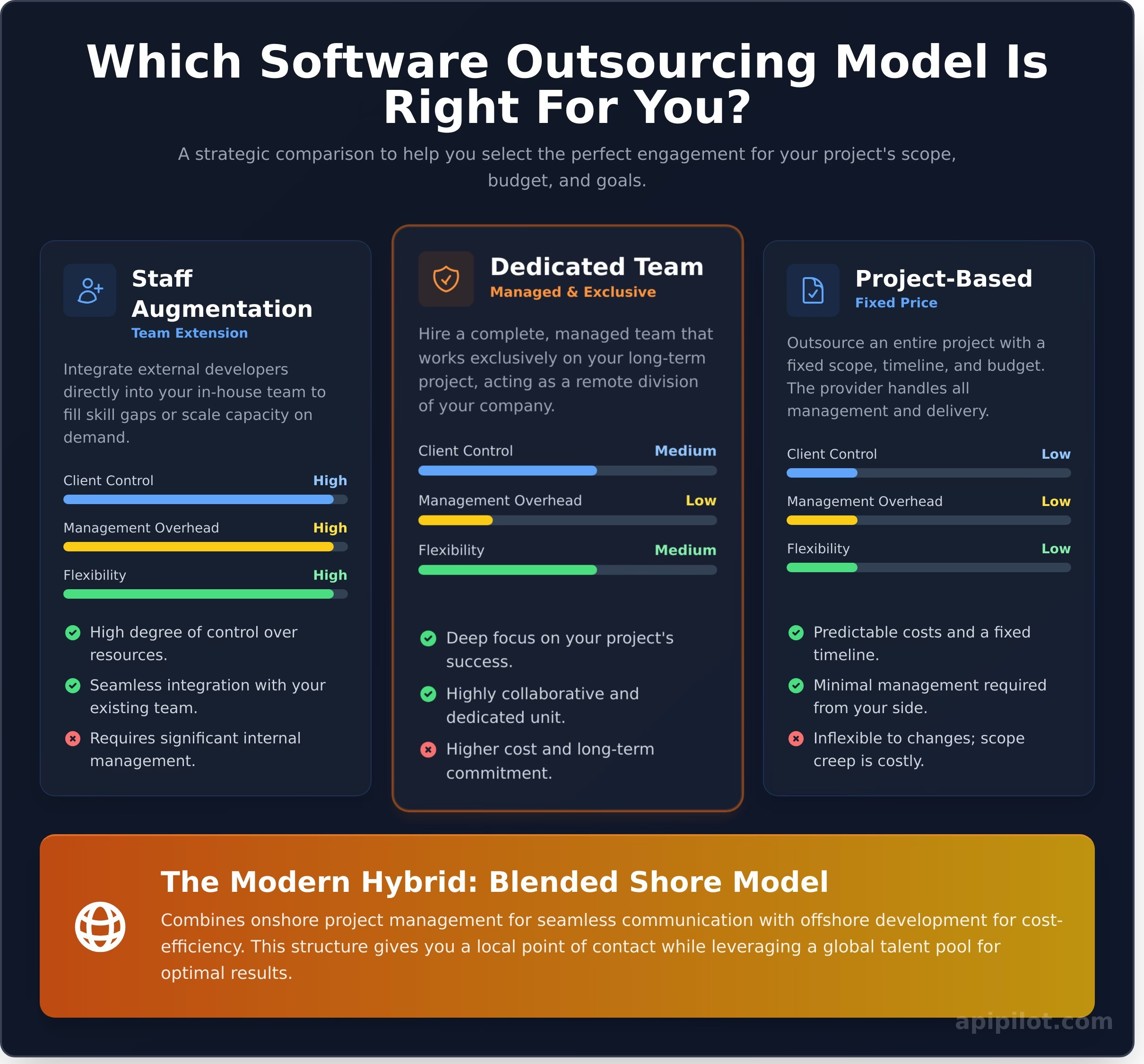
Choosing the right partner for software development outsourcing services starts with selecting the correct engagement model. The best fit depends entirely on your project’s scope, budget, and the level of control you need to maintain. While Gartner’s definition of IT outsourcing provides a high-level framework, the practical application breaks down into several distinct models, each built for different strategic goals. Understanding these options is the first step toward a successful partnership.
Staff Augmentation (Team Extension)
This model involves adding external developers to your existing in-house team to fill specific skill gaps or temporarily increase capacity. They integrate directly into your current workflows and report to your internal managers, acting as an extension of your own staff. It’s a flexible solution for scaling your team on demand.
- Pros: High degree of control over resources and seamless integration with your team.
- Cons: Requires significant internal management and oversight.
Dedicated Team
In this model, you hire a complete, managed team of developers, QA engineers, and project managers who work exclusively on your project. This approach is ideal for complex, long-term projects with evolving requirements where deep domain knowledge and strong team cohesion are critical for success. It functions like a remote, but fully committed, division of your company.
- Pros: Deep focus on your project and a highly collaborative, dedicated unit.
- Cons: Higher cost and commitment compared to other models.
Project-Based (Fixed Price)
The project-based model is the most straightforward: you outsource an entire project with a clearly defined scope, timeline, and a fixed budget. The outsourcing provider takes full responsibility for management and delivery. This is the optimal choice for smaller, well-defined projects where requirements are stable and unlikely to change.
- Pros: Predictable costs, fixed timeline, and minimal management from your side.
- Cons: Inflexible to changes; any scope creep can lead to renegotiations.
The Blended Shore Model: A Modern Hybrid
A modern, hybrid approach, the blended shore model combines onshore project management with offshore development talent. This structure gives you a local, US-based point of contact for seamless communication while leveraging the cost efficiencies of a global team. It’s engineered to deliver the best of both worlds: accountability and value. Discover how API Pilot’s blended model works.
- Pros: Significant cost savings, no time zone issues for management, and high accountability.
How to Choose the Right Software Outsourcing Partner
Selecting a partner for software development outsourcing services is the single most critical factor determining your project’s outcome. While cost is an important variable, the cheapest option often leads to technical debt, communication breakdowns, and missed deadlines. A robust vetting process focuses on long-term value, not just the initial price tag. The goal is to find a reliable, high-performance extension of your own team.
To identify an enterprise-grade partner, your evaluation should be methodical. Focus your due diligence on these three non-negotiable areas:
- Technical Prowess: Do they have the right skills and a proven track record?
- Operational Alignment: Can they integrate seamlessly with your team and processes?
- Security and Compliance: Are your intellectual property and data fundamentally secure?
Evaluate Technical Expertise and Portfolio
A partner’s technical capability must align perfectly with your project’s architecture. Scrutinize their tech stack-do they have proven expertise in the languages and frameworks you need? Analyze their portfolio for case studies that solve problems similar to yours, especially within your industry. Inquire about the experience level and specific certifications of the developers who will be assigned to your build.
Assess Communication and Cultural Fit
Seamless integration depends on frictionless communication. Verify the team’s English proficiency and establish clear communication protocols and tools (e.g., Slack, Jira). It’s also vital to understand their project management methodology. A team that masters Agile or Scrum will deliver iterative value and adapt quickly. Ensure their work culture-their approach to deadlines, transparency, and quality-mirrors your own for a productive partnership.
Verify Security and IP Protection Policies
Your intellectual property is your most valuable asset. Before signing any contract, demand and review their Non-Disclosure Agreement (NDA) and IP protection clauses. Inquire about their data security measures, infrastructure security, and compliance with standards like GDPR or CCPA. A commitment to secure coding practices, such as following OWASP guidelines, is a non-negotiable sign of a professional firm.
Finally, always check references. A confident partner will readily connect you with past clients. Hearing directly about their experience provides invaluable, unbiased insight into the quality of their software development outsourcing services and their ability to deliver on promises.
Mitigating Risks: Overcoming Common Outsourcing Challenges
While powerful, software development outsourcing services introduce variables that require robust management. Potential challenges in communication, quality, and security are valid concerns for any decision-maker. However, with a proactive strategy and a competent partner, these risks are not just manageable-they become opportunities to build a resilient and efficient development process.
A professional partner transforms potential liabilities into strengths by implementing a rock-solid operational framework designed for transparency and performance.
Challenge: Communication Gaps & Time Zones
Seamless collaboration is the bedrock of any successful project. We bridge geographical distances and time zone differences with a communication framework built for clarity and efficiency. This includes:
- A dedicated US-based project manager acting as your single, accountable point of contact.
- Strategic overlapping work hours to ensure real-time collaboration on critical tasks.
- Standardized collaboration tools like Slack, Jira, and Confluence for transparent, asynchronous communication.
Challenge: Ensuring Code Quality
Delivering enterprise-grade software demands an unwavering commitment to quality. We eliminate uncertainty and ensure your codebase is scalable, maintainable, and secure by embedding quality assurance into every stage of the development lifecycle. Our methodology is built on:
- Rigorous code reviews and pair programming sessions to enforce standards and share knowledge.
- Strict adherence to industry best practices and established coding conventions.
- Comprehensive QA testing, integrating both automated test suites and meticulous manual testing processes.
Challenge: Intellectual Property & Data Security
Your intellectual property and data are your most critical assets. We safeguard them with stringent legal and technical protocols, creating a secure environment for development from day one. Our security posture includes:
- Legally binding Non-Disclosure Agreements (NDAs) and IP assignment clauses in every contract.
- Secure, access-controlled infrastructure for all source code, project assets, and sensitive data.
- Regular security audits and mandatory background checks for all engineering talent.
Turning potential pitfalls into strengths is the hallmark of a professional outsourcing partner. A robust framework for managing these risks is a core component of high-quality software development outsourcing services. See how APIpilot builds trust and delivers results.
The Outsourcing Process: From Idea to Launch with API Pilot
A transparent and structured development lifecycle is the foundation of successful software development outsourcing services. It eliminates ambiguity, aligns all stakeholders, and transforms a great idea into a market-ready product with maximum efficiency. At API Pilot, we’ve engineered a battle-tested, four-phase process designed to de-risk your investment and ensure a seamless journey from initial concept to a robust, scalable launch.
Phase 1: Discovery & Strategy
This foundational phase is about deep alignment. We collaborate closely with your team to define clear business objectives and technical requirements. The goal is to build a comprehensive project blueprint that guarantees we are building the right product. Key deliverables include:
- Stakeholder Workshops: Defining core features, user personas, and success metrics.
- Technical Feasibility & Market Analysis: Validating the tech stack and identifying competitive advantages.
- Project Roadmap: A detailed timeline, scope, and cost estimate for full transparency.
Phase 2: UI/UX Design & Prototyping
Here, we translate strategy into a tangible user experience. Our design team creates intuitive user flows, wireframes, and high-fidelity interactive prototypes. This allows you to see, feel, and test the application’s interface before a single line of code is written. We validate every design decision with user feedback, ensuring the final product is both visually compelling and effortless to use.
Phase 3: Agile Development & QA
With a validated design, our engineering team begins development using an Agile methodology. We build the software in iterative two-week sprints, providing you with a demonstrable build at the end of each cycle. This approach allows for continuous feedback and course correction. Quality assurance is not an afterthought; it’s integrated throughout the process to deliver rock-solid, bug-free code.
Phase 4: Deployment & Ongoing Support
A successful launch is more than just deploying code. We manage the entire release process, whether to app stores or live cloud servers, ensuring a smooth transition. Post-launch, we provide active monitoring to guarantee stability and optimal performance. Our commitment extends beyond deployment, with flexible ongoing maintenance and support plans to scale your application and add new features in the future.
Ready to build powerful software with a reliable partner? Explore our software development outsourcing services at apipilot.com.
Partner with API Pilot for Seamless Software Outsourcing
Navigating the world of software development outsourcing services requires a strategic approach. The key to success lies in selecting the right engagement model, meticulously vetting your partner, and establishing a transparent process to mitigate risks. When executed correctly, outsourcing becomes a powerful tool to accelerate development, access specialized talent, and achieve your business objectives with greater efficiency.
At API Pilot, we eliminate the guesswork. Our unique blended-shore model provides the best of both worlds: cost-effective development paired with expert, US-based project management for seamless communication. We leverage a proven agile development process to deliver robust custom mobile, web, and e-commerce solutions faster. We are not just a vendor; we are your dedicated technology partner, committed to turning your vision into a high-performance reality.
Ready to scale your development capabilities and launch your next project with confidence? Schedule a free consultation to discuss your project. Let’s build something powerful together.
Frequently Asked Questions About Software Development Outsourcing Services
How much do software development outsourcing services cost?
Costs vary significantly based on region and developer expertise. Rates can range from $25-$50 per hour in parts of Asia, $40-$75 in Eastern Europe or Latin America, and upwards of $100-$250 for onshore talent in North America. Your final cost depends on the project’s complexity, the required technology stack, and the chosen engagement model. Always request a detailed proposal to understand the complete cost breakdown before committing to a partner.
What is the difference between onshore, offshore, and nearshore outsourcing?
These terms define the geographic location of your outsourced team. Onshore means hiring a team within your own country, ensuring no time zone or cultural barriers. Nearshore refers to a neighboring country with minimal time zone differences (e.g., a US company hiring in Mexico). Offshore involves partnering with a team in a distant country, like Ukraine or the Philippines, which typically offers the most significant cost savings but requires managing larger time zone gaps.
How do I protect my intellectual property when outsourcing?
Protecting your IP is critical. Always start with a robust Non-Disclosure Agreement (NDA) before sharing any project details. Your primary contract must contain a clear intellectual property assignment clause, explicitly stating that all code and work product created belongs to you. Vet your partner’s security protocols and ensure they have a rock-solid reputation for confidentiality and data protection to mitigate all potential risks effectively and secure your assets.
How do you ensure the quality of the software delivered?
A reliable outsourcing partner ensures quality through a multi-layered process. This includes rigorous code reviews by senior developers, a dedicated Quality Assurance (QA) team performing both manual and automated testing, and adherence to agile methodologies with regular sprint demos. Establishing clear acceptance criteria for each feature and maintaining transparent communication are fundamental to delivering a robust, enterprise-grade final product that meets all technical and business goals.
What is the a typical timeline for an outsourced software project?
Project timelines are directly tied to scope and complexity. A Minimum Viable Product (MVP) with core features can typically be developed in 3 to 6 months, while more complex applications can take 9 months or longer. The efficiency of your chosen partner, the clarity of your requirements, and the selected engagement model all play a crucial role in the final delivery schedule. A detailed project roadmap is essential for setting realistic expectations from the start.
Which engagement model is best for a startup?
Startups typically benefit most from flexible models like Time & Materials (T&M) or a Dedicated Team. These models allow for iterative development and changes in scope as the product vision evolves, which is essential in a fast-paced startup environment. A Fixed Price model is often too rigid, as it requires all specifications to be defined upfront. The T&M or Dedicated Team approach provides the agility needed to adapt to market feedback and build a successful product efficiently.