
Master the architectural patterns and technologies required to build web applications that handle massive growth without compromising performance. This guide will walk you through the core concepts, from initial design to advanced strategies, ensuring your application is ready for success from day one.
What is a Scalable Web Application? (And Why You Need One)
In simple terms, scalability is an application’s ability to handle a growing number of users or a larger amount of work without a drop in performance. A scalable web application remains fast, responsive, and reliable, whether it’s serving ten users or ten million. This capability is crucial for business growth, ensuring a positive user experience, maintaining system reliability, and achieving long-term cost-efficiency. Planning for scale from the beginning prevents costly rewrites and downtime as your user base expands. The two fundamental methods for achieving scalability are vertical and horizontal scaling.
Vertical Scaling (Scaling Up): The Simple Start
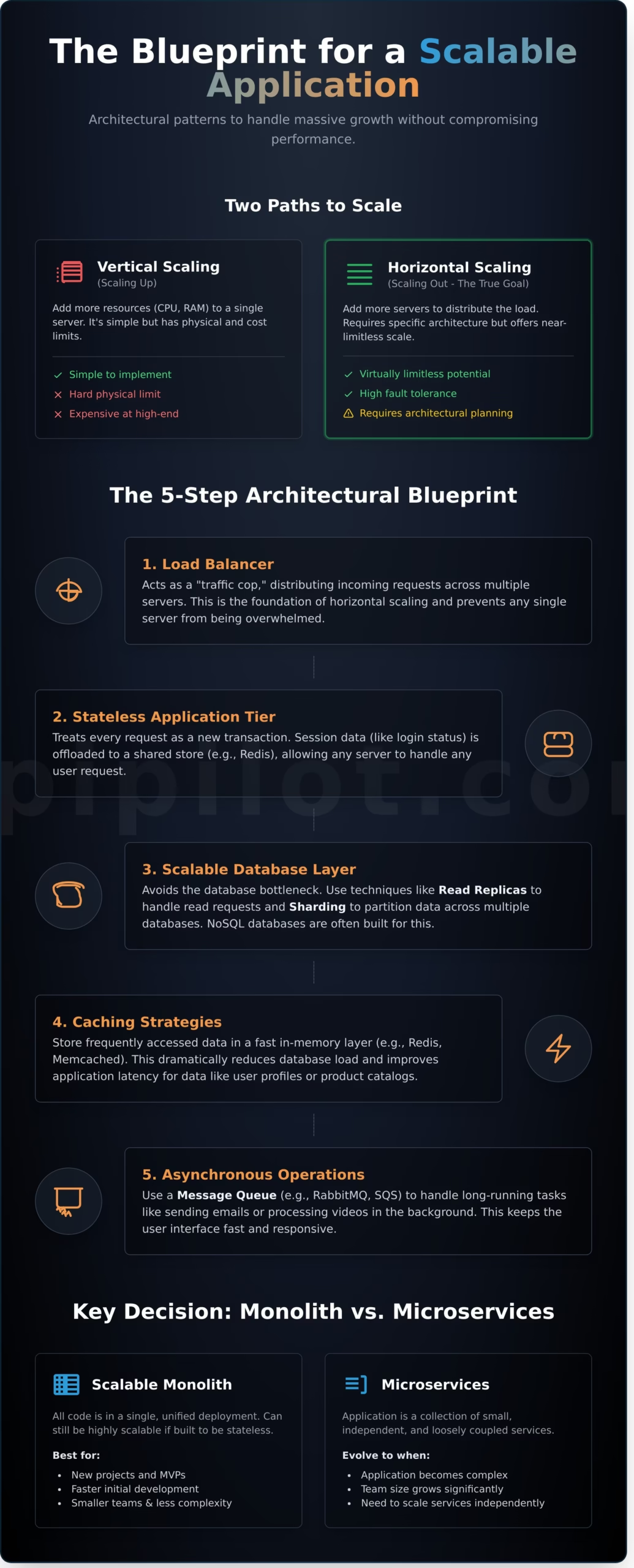
Vertical scaling involves adding more resources, like a faster CPU, more RAM, or increased storage, to a single server. It’s often the first and easiest step developers take to handle increased load. The primary advantage is its simplicity; it typically requires no changes to the application’s code. However, this approach has a hard physical limit. You can only add so much power to a single machine, and the cost of high-end hardware increases exponentially, making it an expensive long-term solution.
Horizontal Scaling (Scaling Out): The True Goal
Horizontal scaling, or scaling out, is the practice of adding more servers to your infrastructure to distribute the application’s load. Instead of making one server more powerful, you add more machines to the pool. This method offers virtually limitless potential to scale and provides higher fault tolerance; if one server fails, the others can pick up the slack. The main trade-off is that it requires a specific architectural design that allows the application to run across multiple machines seamlessly.
The Architectural Blueprint for a Scalable Application
Building a horizontally scalable system isn’t about a single technology; it’s about designing distinct, independent layers that work together. Each layer can be scaled separately, allowing you to address bottlenecks precisely where they occur. Think of these components as the essential building blocks for creating a high-performance, resilient application. A typical scalable architecture involves a load balancer directing traffic to multiple stateless application servers, which in turn communicate with a distributed database layer supported by caching and message queues.
Step 1: Decouple Your Architecture with a Load Balancer
A load balancer is a device or service that acts as a “traffic cop” for your servers. It sits in front of your application servers and distributes incoming network traffic across multiple machines. This is the foundational first step for horizontal scaling because it allows you to add or remove servers from the pool without disrupting service. Load balancers use various algorithms, such as Round Robin (sequentially distributing requests) or Least Connections (sending traffic to the server with the fewest active connections), to ensure no single server becomes overwhelmed.
Step 2: Build a Stateless Application Tier
For horizontal scaling to work effectively, your application tier must be stateless. A stateful application stores user session data (like login status or shopping cart items) on the server itself. This creates a problem when you have multiple servers, as a user’s subsequent requests must return to the *same* server that holds their session data. In contrast, a stateless application treats every request as a new transaction and does not store any session information locally. Instead, state is offloaded to a centralized location, like a distributed cache (e.g., Redis) or a database, allowing any server to handle any user request at any time.
Step 3: Design a Scalable Database Layer
The database is often the first and most significant bottleneck in a growing application. To build a scalable database layer, you need to move beyond a single database server. A common first step is to use read replicas-copies of the main database that handle all read requests, freeing up the primary database to focus on write operations. For applications with massive datasets, you may need to implement database sharding, which involves partitioning data across multiple databases. The choice between SQL and NoSQL databases also impacts scalability; NoSQL databases are often designed for horizontal scaling from the ground up, making them a popular choice for large-scale applications.
Step 4: Implement Caching Strategies
Caching is the process of storing frequently accessed data in a fast, in-memory layer, which dramatically reduces the load on your database and improves application latency. Instead of hitting the database for every request, the application first checks the cache. If the data is there, it’s returned almost instantly. This is highly effective for data that doesn’t change often, such as user profiles, product catalogs, or configuration settings. Common and powerful caching tools include Redis and Memcached.
Step 5: Use Asynchronous Operations with Message Queues
Not all tasks need to be completed instantly. Long-running or resource-intensive operations, such as sending confirmation emails, processing video uploads, or generating complex reports, can block the user interface and degrade performance. A message queue allows you to handle these tasks asynchronously. The application places a “job” onto a queue, and a separate pool of worker processes picks up and completes the job in the background. This decouples the tasks from the main application flow, ensuring the user experience remains fast and responsive. Popular technologies for this include RabbitMQ and Amazon SQS.
Key Decisions: Monolith vs. Microservices
One of the most significant architectural choices you’ll make is whether to build a single, unified application (a monolith) or break it down into smaller, independent components (microservices). The right answer is not universal; it depends heavily on your team’s size and experience, the complexity of your product, and your projected scale.
When to Start with a Scalable Monolith
A monolith is an application where all the code is contained within a single, unified deployment. For new projects and Minimum Viable Products (MVPs), a monolithic architecture is often faster to develop, test, and deploy. It simplifies the initial setup and reduces operational complexity. A well-designed monolith can still be highly scalable, especially if it’s built to be stateless and follows the other principles discussed, such as using a load balancer and offloading tasks to a queue.
When and How to Evolve to Microservices
A microservices architecture breaks an application down into a collection of small, loosely coupled, and independently deployable services. This approach offers significant benefits at scale, including the ability to scale individual services based on their specific needs and the flexibility for different teams to use different technology stacks. The primary triggers for evolving from a monolith to microservices are growing team size (to reduce development conflicts) and increasing application complexity (to make the system more manageable).
Build Your Scalable App with the Right Partner
Designing and building a truly scalable application requires deep expertise and strategic foresight. Making the right architectural decisions early on is critical to avoiding costly mistakes, technical debt, and time-consuming future rewrites. An experienced development partner can provide the guidance needed to build a robust, enterprise-grade application that grows seamlessly with your business. At API Pilot, we specialize in creating custom software solutions that are built for performance and reliability at scale.
Our Process for Building Scalable Solutions
Our approach begins with a thorough discovery phase where we analyze your business goals to design the optimal system architecture. We select the right technology stack that aligns with your specific performance requirements and long-term vision. Through an agile development process, we ensure your application is not just scalable but also flexible enough to evolve as your business needs change. Let’s discuss the architecture for your next project.
Frequently Asked Questions
What is the difference between vertical and horizontal scaling?
Vertical scaling (scaling up) means adding more power (CPU, RAM) to an existing server. Horizontal scaling (scaling out) means adding more servers to your pool of resources to distribute the load.
Should I start with a monolith or microservices for my new application?
For most new applications, starting with a well-structured monolith is faster and more practical. You can plan to evolve to a microservices architecture later as your team and application complexity grow.
Which database is best for scalability: SQL or NoSQL?
Both can be scaled, but they do so differently. NoSQL databases are generally designed for easier horizontal scaling, making them a natural fit for very large datasets. SQL databases can be scaled effectively using techniques like read replicas and sharding, but it can be more complex to manage.
How does cloud hosting (like AWS or Azure) help with scalability?
Cloud providers offer services that make scaling much easier, such as auto-scaling groups that automatically add or remove servers based on traffic, managed load balancers, and distributed databases. They provide the building blocks to implement a scalable architecture without managing physical hardware.
What are the most common mistakes when building a scalable web app?
The most common mistakes include designing a stateful application, having a single database as a point of failure, not implementing caching, and choosing a complex microservices architecture too early in a project’s lifecycle.
Is Kubernetes necessary to build a scalable application?
No, Kubernetes is not strictly necessary, but it is a very powerful tool for managing containerized applications at scale. It automates the deployment, scaling, and operation of application containers, making it a popular choice for managing complex, microservices-based systems.
Building a web application that can handle success is a challenge that requires careful planning and expert execution. By focusing on a decoupled, stateless architecture from the start, you create a foundation that can grow with your user base. If you’re ready to build a robust application designed for performance and reliability, our team has the expertise to bring your vision to life. Ready to build an application that scales? Contact our experts today.
Planning a web application? See how our web application development team builds scalable, secure platforms for US businesses, then request a free estimate.