In a competitive market, efficiency is paramount. Businesses often turn to off-the-shelf software to manage their operations, only to find themselves constrained by generic features and inflexible workflows. The alternative—tailor-made software—offers a powerful solution built to your exact specifications. This guide will explore the key advantages of custom software, helping you understand how it solves unique business challenges, boosts efficiency, and delivers a powerful long-term return on investment over off-the-shelf solutions.
What is Tailor-Made Software vs. Off-the-Shelf?
Understanding the fundamental differences between custom and pre-packaged software is the first step in making a strategic technology decision. While both have their place, they serve fundamentally different purposes.
- Tailor-Made (Custom) Software: This is a software application designed, developed, and implemented for a specific user or organization. It is built from the ground up to address precise needs, workflows, and business objectives that generic software cannot fulfill.
- Off-the-Shelf (COTS) Software: This refers to a ready-made software product available to a mass audience. It offers a broad set of features to serve a wide range of customers, but often forces businesses to adapt their processes to the software’s limitations.
The core issue with COTS software is that it often requires you to change your proven business processes to fit its rigid structure, leading to inefficiencies and compromises.
Custom vs. COTS: A Quick Comparison Table
| Attribute | Custom Software | Off-the-Shelf Software |
|---|---|---|
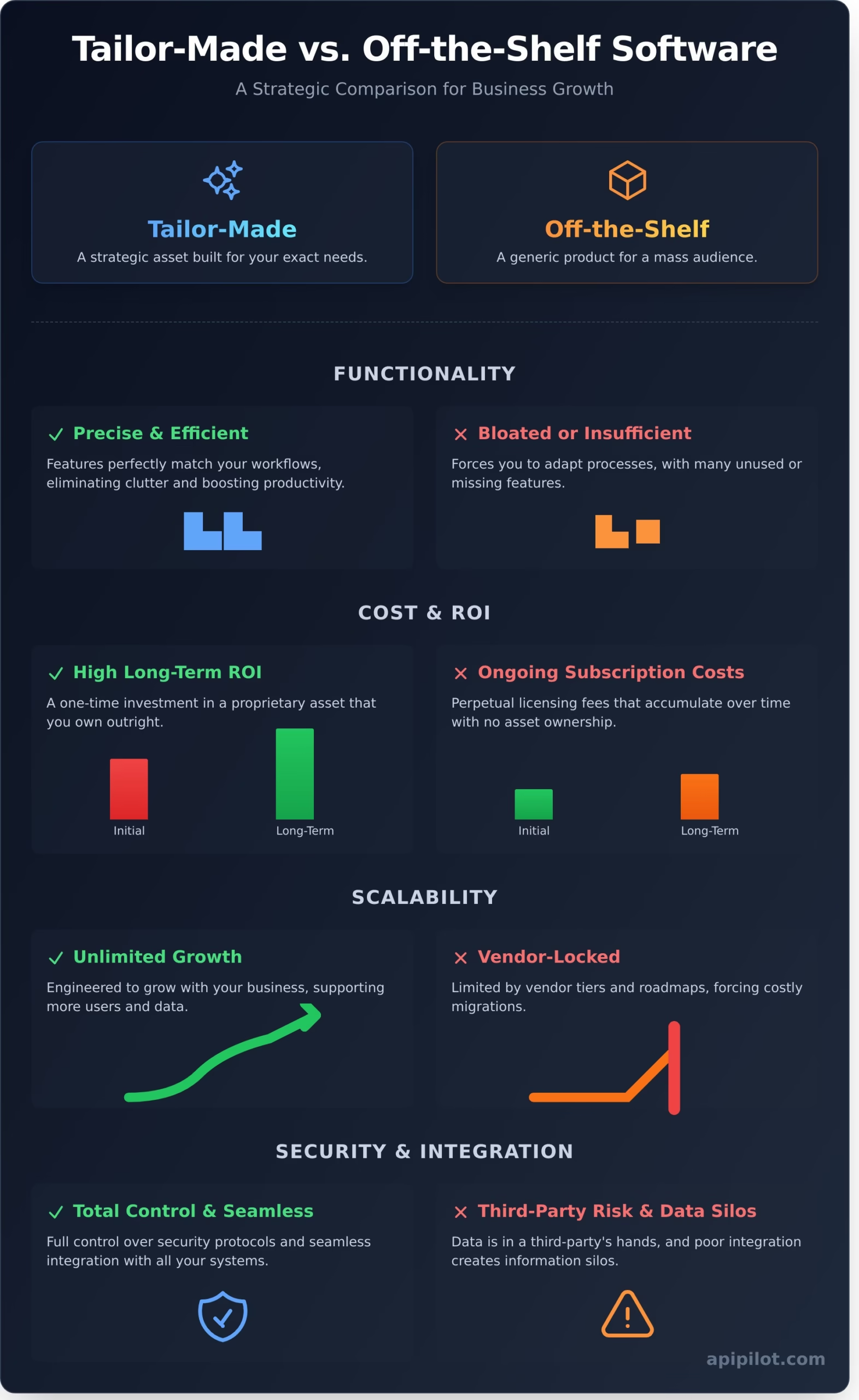
| Functionality | Built precisely for your needs with only the features you require. | Generic features that may be bloated or insufficient. |
| Initial Cost | Higher upfront investment. | Lower initial cost or subscription fee. |
| Long-Term ROI | High, due to increased efficiency, no licensing fees, and asset ownership. | Lower, with ongoing subscription costs and potential productivity losses. |
| Scalability | Designed to grow and evolve with your business. | Limited by the vendor’s development roadmap and tier structure. |
| Integration | Seamlessly integrates with any existing or future systems. | Limited integration capabilities, often requiring workarounds. |
When Off-the-Shelf Software Creates More Problems Than It Solves
Many businesses initially adopt COTS solutions for their low entry cost, but soon encounter significant obstacles. These challenges often include:
- Inflexible workflows that slow down your team and force them into inefficient, multi-step processes for simple tasks.
- Paying high subscription fees for a suite of bloated features, of which your team might only use 20%.
- Creating data silos because the software doesn’t properly integrate with other critical business systems, requiring manual data transfer and leading to errors.
Top Advantages of Investing in Tailor-Made Software
Investing in tailor-made software is a strategic move that directly addresses the shortcomings of generic solutions. Each of the following advantages translates directly into measurable business growth, enhanced productivity, and a stronger bottom line.
1. Unmatched Efficiency with Custom Workflows
The primary benefit of tailor-made software is its ability to perfectly match your unique business processes. Instead of adapting your workflow to fit the software, the software is built around your team’s needs. This allows you to automate repetitive tasks, eliminate manual data entry, and streamline complex operations. By including only the features you need, you reduce interface clutter and shorten the learning curve, empowering your team to work faster and with fewer errors.
2. Total Scalability: A Solution That Grows With You
Off-the-shelf software often hits a wall. You might outgrow its user limits, data storage capacity, or feature set, forcing a costly and disruptive migration to a new system. Custom solutions, however, are built with your future in mind. They are designed to be fully scalable, allowing you to add new features, support more users, and handle increased data loads as your business expands. This ensures your technology remains an asset, not a bottleneck.
3. Seamless Integration with Your Existing Systems
Modern businesses rely on a diverse ecosystem of tools, from CRMs and ERPs to accounting software and marketing automation platforms. Custom software can be engineered to act as the central hub, seamlessly integrating with all your other systems via APIs. This creates a single, unified source of truth for your business data, breaking down information silos between departments and enabling powerful, data-driven decision-making.
4. Enhanced Security and Data Control
With generic software, you are entrusting your sensitive business data to a third-party’s security protocols. A vulnerability in a popular COTS product can put thousands of companies at risk. With tailor-made software, you can implement robust security measures specifically designed for your industry regulations and data sensitivity. You have full control over data access, hosting, and compliance, significantly reducing your risk profile.
5. Long-Term ROI and Cost-Effectiveness
While the initial investment in custom software is higher, the long-term return on investment is substantial. You eliminate recurring monthly or annual licensing fees that add up over time. More importantly, the gains in productivity, reduction in manual errors, and streamlined operations lead to significant cost savings. You are investing in a valuable, proprietary business asset that you own outright, rather than renting a temporary solution.
6. A Powerful Competitive Advantage
Perhaps the most strategic benefit of tailor-made software is that you own the intellectual property (IP). This allows you to develop unique features, proprietary processes, and innovative services that your competitors using off-the-shelf software simply cannot replicate. You can pivot and adapt to market changes instantly, without waiting for a software vendor’s next update cycle. This technological agility becomes a core part of your competitive edge. See how our custom solutions drive innovation.
Is Custom Software the Right Move for Your Business?
Choosing to build custom software is a major strategic decision and isn’t the right fit for every single business need. However, for core business functions, it can be transformative. Use this checklist to evaluate if it’s the right path for your organization.
A 5-Point Checklist for Choosing Custom Development
- You have a unique business process that provides a clear competitive advantage and cannot be replicated by standard software.
- You need to integrate multiple, complex, or legacy systems that do not communicate with each other effectively.
- Off-the-shelf solutions require too many expensive workarounds, customizations, or manual processes to be functional.
- Data security, control, and industry compliance are critical, non-negotiable business requirements.
- You view technology as a long-term capital asset and a driver of growth, not just a short-term operational expense.
Addressing Common Concerns: Cost, Time, and Support
Decision-makers often hesitate due to valid concerns about the development process. Here’s how a professional partner addresses them:
- Cost: View the initial price not as an expense, but as a capital investment in a long-term asset. The ROI from efficiency gains and eliminated subscription fees provides a clear financial justification.
- Time: Modern agile development methodologies focus on delivering value incrementally. You don’t have to wait for the entire project to be finished; a Minimum Viable Product (MVP) can be launched quickly to start generating value while further features are built.
- Support: Reputable development firms don’t disappear after launch. They offer ongoing maintenance and support retainers to ensure your software remains secure, updated, and aligned with your evolving business needs.
How API Pilot Delivers Tailor-Made Excellence
The success of a custom software project depends heavily on the expertise and process of your development partner. Choosing the right team is crucial for turning your vision into a high-performance reality. Our process at API Pilot is designed for clarity, efficiency, and delivering measurable results.
Our Development Process: From Discovery to Deployment
We guide you through a structured, transparent process at every stage. It begins with a deep-dive Discovery phase to fully understand your goals and requirements. This informs the Design phase, where we create intuitive user interfaces and robust architecture. During Development, our expert engineers bring the vision to life, followed by rigorous Quality Assurance (QA) to ensure a flawless final product. Finally, we manage the Launch and provide ongoing support to ensure your success.
Ready to Build Software That Fits Perfectly?
Stop forcing your business operations into a box that doesn’t fit. It’s time to build a solution that streamlines your workflows, empowers your team, and provides a true, lasting competitive advantage. Let’s have a conversation about your unique challenges and strategic goals.
Frequently Asked Questions
How much does tailor-made software cost?
The cost varies widely based on complexity, features, and integration points. A simple application might start in the tens of thousands of dollars, while a complex enterprise system can be a significant six-figure investment. The key is to focus on the long-term ROI, not just the initial price.
How long does it take to develop custom software?
Timelines depend on the project’s scope. A simple MVP can often be developed in 3-4 months, while larger, more complex applications can take 6-12 months or longer. An agile approach ensures you see progress and can provide feedback throughout the process.
Who owns the intellectual property of the custom software?
When you partner with a reputable firm like API Pilot, you, the client, own 100% of the intellectual property, source code, and all associated assets upon final payment. It becomes your proprietary asset.
What is the difference between bespoke software and custom software?
The terms “bespoke software” and “custom software” are generally used interchangeably. Both refer to software developed specifically for a single organization’s unique requirements.
Is custom software more secure than off-the-shelf software?
It can be significantly more secure. Because it’s not widely used, it’s a less attractive target for hackers. Furthermore, you can build security protocols and compliance measures directly into the architecture to meet your specific needs, rather than relying on a generic vendor’s security standards.
Don’t let inadequate software dictate your business’s potential. By investing in a solution built for you, you unlock new levels of efficiency and innovation. Build the exact software your business needs. Schedule your free consultation.